Showing posts with label aeroplane. Show all posts

Friday, July 4, 2025

Giant Plane, Dense Crowd


I love airshows—so photogenic, so much to see, all manner of weather conditions and lighting angles. I’ve shot in everything from dust storms to overcast, and soaring temperatures too. But there’s nothing like the smell of burning kerosine when vintage planes are on the move! I took this shot at the RAAF Edinburgh Airshow on the 10th of November 2019, my last airshow before the viral apocalypse took hold, and had the fun of airing two cameras on the day. The resolution is of course higher than the old S-5600, and the chip handles bight light very well, but I’m not sure this unit handles low light better than the older model. Here is a view from the stands across the apron to the RAAF C-17 Globemaster III transport plane, which I first photographed at Avalon Airshow in 1997. They’re gigantic and always very attractive for their dynamic appeal. The day was hot, dusty (very dusty) and quite taxing, but an unforgettable experience. Minor tweaks in Irfanview only. Fuji HS-10. Image by Mike.

Monday, June 29, 2009

Ephemeral Subject


Click image to view at 1000 pixels wide

Some subjects are there and gone in moments, and you need to anticipate their appearance to catch them on film (or in pixels). Fast-moving subjects fall in this category, and when an aerobatic plane trails smoke it makes pictures in the sky which have the beauty of the physics of fluid mechanics. Here I'm photographing the aerobatic display by the Extra 300s type, flown by Paul Andronicou at the Goolwa Classic Airshow, February, 2007, and while the aircraft itself is the subject matter it becomes visually conjoined with its smoke trail, so the corporate effect is the sense of motion the audience receives. In this sense, the smoke is as important as the aircraft in the aesthetic effect they generate, and the photographer must mot try to zoom solely on the aircraft and track its motion to the exclusion of all else -- it's not possible, for one thing, and you miss the visual suggestion of motion in the smoke if you do. This image was cropped to achieve composition, and sharpness and colour were enhanced. Fuji FinePix S5600, image by Mike.

Friday, June 12, 2009

Slow Burn Image


Click image to view at 1000 pixels wide

Having experimented with faster virtual filmspeeds and encountered 'digital grain' in the 800 ASA range, I'm actually glad I stayed with 200 ASA and played the camera-motion game at my shoot at the RAF Museum, Hendon, in December, 2006. This is their Lancaster bomber and shooting a black aeroplane in a huge building in which the lumens were never quite right for photography was a technical challenge, but the clarity and liquid-smoothness of the 5mp image were in fact worth it. I saw a photo taken at the Lancaster assembly line during WWII, an early colour negative, with a filmspeed so slow you could see the ghost-images of technicians who were walking through the frame. To my amazement, the same thing appeared in this shot: note the patron at far right. This tells you how long the exposure was. The camera was held solidly against a column to eliminate motion, then the chip simply did its thing with the exposure, rendering a very pleasing final result. Sharpness and colour were enhanced. Fuji FinePix S5600, automatic. Image by Mike.

Tuesday, May 26, 2009

Ships in the Glare


Click image to view at 1000 pixels wide

It's always worth keeping your neck screwed round and your camera on the window when you're flying, you never know quite what you'll see. If you're in the cheap seats, you get a great view of the wing, and it does interesting things, like completely reconfiguring for approach, with spoilers up and truly impressive flaps down. The wing blocks your view forward so the scenery appears below you, and sometimes it can be amazing. I shot a long series of frames on approach to Singapore on my way home in November 2007, and captured several shots of the merchant fleet lying off the islands, mile after mile of ocean scattered with freighters and tankers, a truly spectacular sight. Add in the sun angle, glare from the sea, and the aerospace interest of the wing, and it makes for an image that would have been science fiction fifty years ago. I didn't bother squaring this one up as the tilt gives a feel for the motion of the aircraft. Sharpened and colour-enhanced only; Fuji FinePix S5600, automatic. Image by Mike.

Tuesday, February 24, 2009

Islands in the Haze


Click image to view at 800 pixels wide

You never truly appreciate what air pollution means until you see some place that has it bad. London may be one of the biggest cities in the world but the air quality is not so different, at least visibly, to cities in Australia. Don't be fooled by the Qantas logo on the aircraft, this picture was taken in China, through the window of a Boeing 747 taxying for takeoff after a refurbishment stopover at Kai Tak Airport, Hong Kong. The pollution was like a false dusk the aircraft dived into on approach, just before dawn, and when the sun came up it lit a haze so dense the other side of the bay was barely visible, and high-rise apartment blocks are half-seen strips of light and dark through a grey nothingness. The struggle here was to not only keep the camera straight and level, or to keep dirt on the window out of the shot, but to find enough light for photos to have acceptable contrast. The 'thick' air hazes everything, buildings and aircraft less than half a mile away already show the visual effects of the pollution. This one, with the properly-lit and contrasty foreground, with the island and buildings almost lost in the haze though they're only a couple of miles away, makes a dramatic statement of this issue. October, 2007; Fuji FinePix S5600, automatic. Image by Mike.

Sunday, February 8, 2009

The Right Size for Flash


Click image to view at 800 pixels wide.

Probably the one significant shortcoming of the Fuji FinePix S5600 is the limited power and range of its flash. Any more than eight feet back from a subject and you're in trouble, and as for snapping a group shot at a concert, be ready to do digital enhancement to bring up the mid-tones and generally brighten the pic. Therefore, when you're shooting something as large as an aircraft in conditions of low light, flash is essentially not an option. This is the Phantom FGR.2 in the RAF Museum, Hendon, on the north side of London, and I was frustrated by the conditions: in the cracks between light too low for my filmspeed and subject too big for the flash. (Change filmspeed, duhhh, but I was worried about 'digital grain' at the time and preferred to practice the art of holding the camera steady.) But detail closeups are another matter, and the cockpit was just the right size to floodlight with flash. Harsh contrast, of course, but the flash found the details of the grey and black instrument panels, and for those interested in the F-4 cockpit for its own sake, this is the right sort of picture to take. December 2006; image by Mike.

Saturday, January 31, 2009

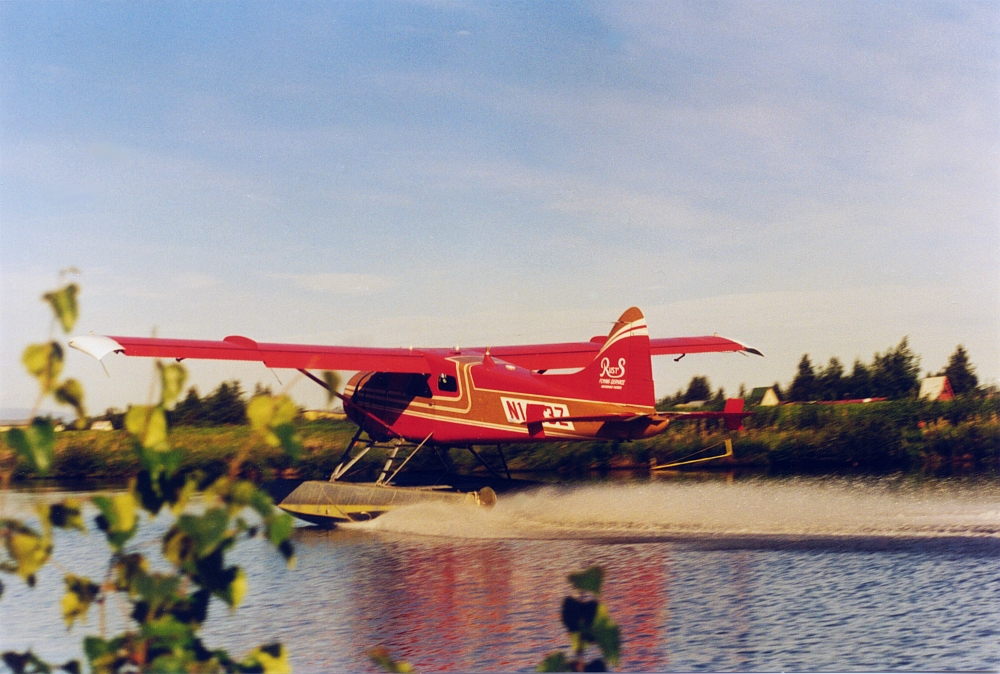
An aviation icon of the north

Red-floatplane-lake-hood
Click here to view the whole image at 1000 pixels wide.

A lot of pilots will tell you that the DeHavilland DHC-2 Beaver is the easiest plane in the air to fly, and watching this one skip in and out of Lake Hood -- which is the world's busiest float plane harbor, in Anchorage, Alaska -- I can believe it. The Beaver has an amazing history and is an icon in Arctic Canada. The skies in the north are still full of them. This one is operated by Rust Flying Services, and is still in the air, still working -- you can see it on Rust's website's homepage! This photo was captured in 1997, on a glorious day in August. The weather was warm, which is very unusual for August in Alaska (folks said I'd brought the good weather with me; and wouldn't you know it? It quit just as I left). I was shooting on 200 speed film, which was all I had left when I got this picture. Because the film was not so fast, you'll notice the background blurred as I tracked with the aircraft ... which adds to the effect. The film was not developed till I got back to Australia, and I discovered the undeveloped roll had been damaged by going through about nine airport x-ray machines. All the images have an overall yellow cast. To get around this, the old print was scanned at 600dpi and deeply enhanced for sharpness, contrast, brightness -- and color. Then it was touched up to get rid of about forty "ufos" -- faults in the photo paper on which it had been printed, so long ago. The result is very nice -- and for me, full of memories. The integrity of the shot tells me the camera was one of my Pentax K-1000s, and the film was certainly Kodak Royal Gold 200. Photo by Mel, 1997.

Wednesday, January 21, 2009

A Case for Filmspeed Adjustment...


Click image to view at 800 pixels wide

My UK trip in late 2006 was my first really major digital foray, at least with an up to date camera with sophisticated capabilities. I wasn't clear on many of the functions and had heard all sorts of conflicting stories about just how digital photography compared and contrasted with the physical age. Show me a Pentax K1000 and a roll of film, and I'll make it sit up and talk... "Virtual grain" was a concept I was worried about, and preferred to minimise motion than risk resolution damage, especially as I was looking to cram as many shots as possible onto my flashcards and was shooting at only 2mp to start with. This shot was taken at the RAF Museum, Hendon, in the northern suburbs of London, in early December '06. You might think that so many lights glaring off polished aluminium would make for ample illumination, but not so: with a filmspeed of 200 selected, to increase light gain but still stay safely in the fine-grain range, the camera was on the verge of motion problems all the time. I started using steadying supports -- beams, railings, anything. In this shot of the B-17G, the camera is on top of a post in the walkway fence -- see it snaking toward the POV at left? Don't even ask about flash, the FinePix S5600's flash wouldn't reach as far as the propellers. Of course, it turns out I could have raised the filmspeed by a factor of four before encountering virtual grain, but I didn't know that at the time... Photo by Mike, 2006.