Showing posts with label Greenwich. Show all posts
Monday, October 21, 2024
Compressed Perspective
The magic of the telephoto lens is making the middle distance seem close and the distant seem a lot nearer than it is. When you combine the two elements, the compression is delightfully deceptive. Here’s a simple shot taken around early November to December, 2007 (I don’t seem to have an exact date available) on my one and only visit to the Royal Observatory, Greenwich, to the east of London. (Yes, I stood with a foot each each hemisphere, astride the prime meridian, as everyone does!) This is a zoom shot and the outdoor cafe area in the foreground is seen against the Millennium Dome, which must be a couple of kilometres away on the other side of the Thames. It's also an exercise in pulling information out of the dark foreground without burning out the background, so the chip handled the situation very well indeed, requiring only minor tweaks to gamma value, contrast and colour. Fuji S5600. Image by Mike.
Labels:
architecture,
England,
Greenwich,
Greenwich Park,
London,
outdoors,
telephoto photography
Friday, July 24, 2009
River Cruising in London
Click image to view at 1000 pixels wide
The Greenwich Reach lends itself to panoramic imagery wonderfully. This shot was cropped from a standard frame, taken in November, 2007, from the shores of the Thames between the Royal College of Music and the Cutty Sark's drydock. The sleek, futuristic Thames Clippers are a usual sight, the tour boats plying up and down this famous, historic river through the heart of one of the world's greatest cities. Technically, composition was the object here: I framed the city and waited for the boat to cruise into just the right place before releasing the shutter. The picture was enhanced in the usual way, sharpened and contrast-balanced. Fuji FinePix S5600, automatic. Image by Mike.
Thursday, July 23, 2009
Prime Meridian
This piece of what appears to be modern sculpture is the marker at the Royal Observatory, Greenwhich, London, showing the line of zero degrees (the metal strip recessed in the ground), the 'prime meridian' of the world from which navigation calculations derive. There have been others in the past, the French had a coordinate system with zero passing through Paris, and I believe there was a Russian system based on Moscow. This one is a tourist mecca, and everyone needs to stand with a foot in each of the eastern and western hemispheres at once. The oblique 'mast' of this gyroscope-like structure is almost certainly aligned on the celestial north pole, therefore reproducing the axial tilt of the Earth. The photograph was a simple composition piece in which the principle challenge was taking it in the moments when the monument was not obscured by the thronging visitors. Sharpened only. November, 2007; Fuji FinePix S5600, automatic. Image by Mike.
Labels:
England,
Greenwich,
London,
Royal Observatory
Tuesday, June 16, 2009
The Millenium Dome
Click image to view at 1000 pixels wide
London's Millennium Dome was built as an exhibition pavilion to mark the change of century, on a reclaimed industrial site in Greenwich. It was a controversial project seen as a money-pit by many. Open during the year 2000 with millennium-related exhibitions, it fell into disuse and has subsequently been revitalised as part of "The O2" entertainment district. I took this shot at high telephoto at the beginning of November, 2007, as my plane was circling London waiting for landing permission. The softness of the image is due to the acute angle through the window, and the colour, contrast and sharpness were all adjusted to maximise the result. Fuji FinePix S5600, automatic. Image by Mike.
Labels:
aerial photography,
England,
Greenwich,
London,
Millenium Done,
Thames
Monday, May 11, 2009
Greenwich Reach
Click image to view at 1000 pixels wide
Supercities of the future are a reality today: one look at Tokyo, Hong Kong, Los Angeles or London confirms that. This is the latter, a long telephoto shot over the river seen from the Royal Observatory on the hill at Greenwich in November 2007, a place from which, in one glance the eye can scan from the Millenium Dome, over Christopher Wren's hospital buildings begun before 1700, to the new organic tower Londeners christened "The Pickle" for its oblate shape. How many cranes can you count? It's always a game, counting tower cranes on the skyline: London will be a nice town if they ever get it finished. Note the "Thames Clipper" at a landing stage on the river.
The image was sharpened and colour-enhanced, and contrast was brought up somewhat, but the most interesting digital modification was rotation. The frame when taken was off-true, the horizon line was down on the left (a symptom of pressing a shutter release on the right of the camera and most often found in either reflex shooting or subject matter whose outline biases the brain's orientation system to its shape, rather than to what's perpendicular. The arc of the river had such an effect.) It was corrected using Irfanview, a very powerful (free) image manipulation program which includes an incremental rotation routine allowing fractions of a degree. I rotated the image one degree to square up the edges of towers to the vertical. This resulted in a matted area, a series of wedges at the edges of the frame where the image has shrunk slightly within its own boundaries to accommodate the rotation without area loss. I cropped inside these wedges, then proceeded as normal. Fuji FinePix S5600, automatic, telephoto. Image by Mike.
Supercities of the future are a reality today: one look at Tokyo, Hong Kong, Los Angeles or London confirms that. This is the latter, a long telephoto shot over the river seen from the Royal Observatory on the hill at Greenwich in November 2007, a place from which, in one glance the eye can scan from the Millenium Dome, over Christopher Wren's hospital buildings begun before 1700, to the new organic tower Londeners christened "The Pickle" for its oblate shape. How many cranes can you count? It's always a game, counting tower cranes on the skyline: London will be a nice town if they ever get it finished. Note the "Thames Clipper" at a landing stage on the river.
The image was sharpened and colour-enhanced, and contrast was brought up somewhat, but the most interesting digital modification was rotation. The frame when taken was off-true, the horizon line was down on the left (a symptom of pressing a shutter release on the right of the camera and most often found in either reflex shooting or subject matter whose outline biases the brain's orientation system to its shape, rather than to what's perpendicular. The arc of the river had such an effect.) It was corrected using Irfanview, a very powerful (free) image manipulation program which includes an incremental rotation routine allowing fractions of a degree. I rotated the image one degree to square up the edges of towers to the vertical. This resulted in a matted area, a series of wedges at the edges of the frame where the image has shrunk slightly within its own boundaries to accommodate the rotation without area loss. I cropped inside these wedges, then proceeded as normal. Fuji FinePix S5600, automatic, telephoto. Image by Mike.
Labels:
architecture,
England,
Greenwich,
image rotation,
London,
river,
telephoto photography,
Thames
Monday, April 13, 2009
The Old Royal Naval College

Click image to view at 1000 pixels wide
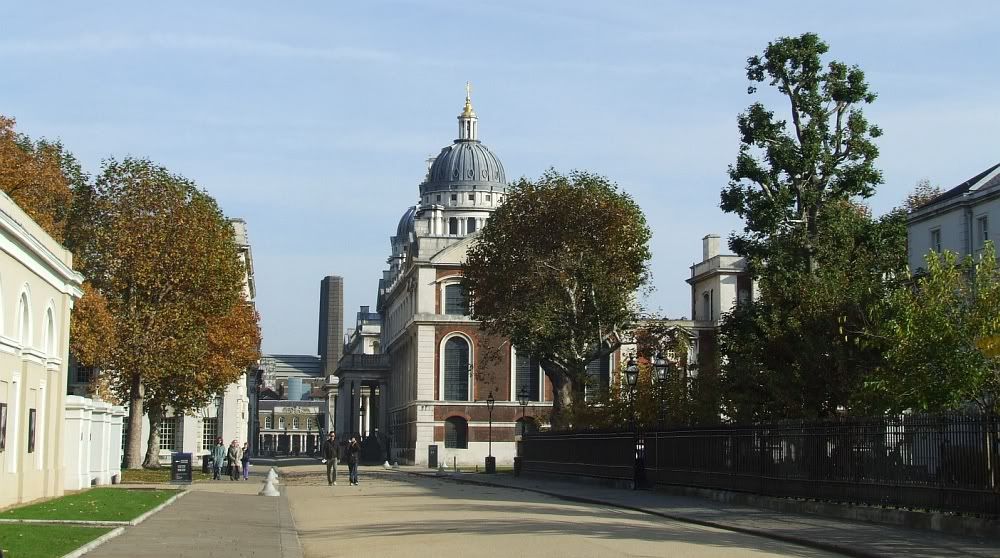
These streets are over 300 years old. The architectire is timeless and to see these buildings on a sunny afternoon is to blink and see the fashions of the 18th century strolling by. Designed by Christpher Wren, they were begun in 1696 as the Greenwich Hospital, and from 1873 to 1998 they housed the Royal Naval College. The Royal College of Music is now in residence. I took this photograph in November, 2007, on a bright Sunday afternoon, and Maritime Greenwich made a considerable impression on me. The shot was a simple frame and shoot, and the image has been cropped for publication (excess sky and foreground trimmed to create a panorama), and the sharpness and colour have been adjusted slightly. Fuji FinePix S5600, automatic. Image by Mike.
Labels:
architecture,
built environment,
England,
Greenwich,
heritage,
London,
universities
Tuesday, April 7, 2009
The Bellot Memorial
It's an amazing contrast, an Egyptian obelisk whose native environment is the heat and dust of the Middle East, or at best the green vales of the Nile, yet here it is framed by the deciduous leaves of an English autumn, in fact winter. This obelisk stands on the banks of the Thames in the grounds of the Royal College of Music (which inhabits the buildings erected at the end of the 16th century as the Seamen's Hospital). It's not an original brought from Egypt, this one was built in the 1850s as a commemoration of a young French adventurer, Joseph Rene Bellot, who died in 1853on an expedition searching for the missing ships of Sir John Franklin in the Canadian Arctic. Thus it's extremely fitting that it was built at Maritime Greenwich, a stone's throw from where the Cutty Sark has lain since 1950. The image was taken at high telephoto from outside the boundary railings, the framing excluding buildings and the endless London skyline, and the colour, contrast and focus were tweaked for publication. Fuji FinePix S5600, automatic; November, 2007. Image by Mike.
Sunday, January 25, 2009
Aspiring to Understanding
The symbolism in this image is so strong -- the Royal Observatory, Greenwich, featuring the solar telescope through which passes the Prime Meridian (zero degrees) of the world's modern navigational reference system, against a clear winter sky in mid-November 2007, laced with the contrails of international flights passing over London. The observatory is a standing museum to the sciences of astronomy, navigation and timekeeping, so vital to the exploration of the world in the days when sail ruled the seas. Two centuries later new forms of transport have taken over, created by engineers who stood on the shoulders of the giants of the past. The photograph was a simple one, a mere snapshot, but the material so offered itself to the lens! Fuji FinePix S5600, automatic. Photo by Mike, 2007.
Labels:
England,
Greenwich,
London,
observatory,
Royal Observatory,
sky,
structures
Subscribe to:
Posts (Atom)