Showing posts with label museum. Show all posts

Sunday, July 5, 2026

The Grand Old Institution


This is the Natural History Museum, on Cromwell Rd. in London, which from the outside still looks much as it did when it opened in April, 1881. Brainchild of Sir Richard Owen, that “Count Dracula” of palaeontology, it has always been one of the leading institutions of its kind in the world. I photographed it on November 1st, 2010, on my third UK trip; this was the second time I visited London’s South Kensington museum district, and it was also the last time I had the chance to do so. Distance and cost are relentless, after all. I was really under the weather on that trip, so was unable to appreciate the sights as they deserved—still, I brought home the pictures, and I have them to this day. This is a simple street snap, but at least I managed to hold the camera square! I remember the sun being so low in the sky, despite a late morning time, that most of the street was in deep shadow. Minor adjustments to colour, contrast and sharpness in Irfanview; Fuji FinePix S5600. Image by Mike.

Sunday, November 16, 2025

Looking Back a Hundred Years

Here is an interesting scene—a British railway platform, c. 1920s, as recreated in meticulous detail in the National Railway Museum, York. Here one steps back a century—no digital screens, no neon lights, nothing post-dating the era of steam and newspapers. This is the world of P G Wodehouse and Agatha Christie, when movies were silent and radio a novelty. This is the genius of the museum scenario, a kind of immersion in which you can look into another time. The light levels in the museum are quite soft, so I was holding the camera against a vertical surface for stability, and did quite well—the light gathering ability of the old technology was only a fraction of today’s point-and-shoot ability. Supporting the camera during long exposures became second nature. I took this shot on my UK trip of November, 2011, the last time I visited the NRW, and it certainly appeals to my fascination with vanish point symmetry. Minor adjustments to contrast and sharpness in Irfanview; Fuji FinePix S5600. Image by Mike.


Thursday, August 28, 2025

Perfection in Miniature

I’ve featured art treasures on occasion, and here’s one that truly took away my breath. This is carved wood, and just a small detail from a tremendous altarpiece, carved nearly five hundred years ago in Lombardy. I photographed it on November 1st, 2010, in the Victoria and Albert Museum, London, during my third trip. Besides the jaw-dropping skill of the artist, what makes it interesting as a photograph? The piece is of course behind glass, and artificially illuminated, and gave all kinds of difficulty in maintaining focus, keeping the camera still (low ISO in those days) and finding an angle to exclude the reflection of lights in the glass. That small blue blob at the top is the only reflection. I took many frames but the inherent difficulty meant few came out really well. Minor adjustments to contrast and sharpness in Irfanview; Fuji FinePix S5600. Image by Mike.


Sunday, June 16, 2024

Roman Corner

I’m sure there’s a wealth of history about this exhibit at the Victoria and Albert Museum, South Kensington, London, but I think of it simply as ”Roman Corner.” One walks through here between one part of the classically-appointed museum and another, but this particular area recreates ancient times—the statue is probably original, and the marble probably all comes from Italy. If you look in the right direction for a moment, you could be two thousand years ago, in a well-to-do house of a lost civilisation. I took this photograph on November 1st, 2010, my one and only (to date) visit to this amazing museum. Contrast and colour were increased a little, as was sharpness. Fuji FinePix S5600. Image by Mike.


Thursday, January 11, 2024

Still Life?

This is a most interesting piece—Dale Chihuly’s chandelier for the rotunda of the Victoria and Albert Museum in South Kensington, London. It was created in 2001 and I photographed it on November 1st, 2010, during my third UK trip. It’s a confection of blown glass, drawing on the Murano techniques of Venice, according to the V&A’s website. It creates a flowing sense of motion in a still object and its towering, extended, pseudo-organic form puts one in the mind of life, though not of any recognisable form. This was a straight forward snapshot, one of several of this subject, using the background architecture to frame the glass confection. It makes a most futuristic picture, oddly juxtaposing the classical architecture of the building with the surreality of the art. The only adjustments were a touch of contrast and sharpness. Fuji FinePix S5600, automatic. Image by Mike.

Wednesday, August 12, 2009

Metal and Complex Light


Click image to view at 1000 pixels wide

Here the POV is under the tail of the DeHavilland Sea Venom at the Fast Jets Fighter Museum, Parafield Airport, north of Adelaide, taken in January, 2007, and the range of tonal values the chip has gathered are striking. The shadow areas have been adequately registered, while the main lighting source is burned out, yet the general colours of the environment have been captured with great truth. The image was sharpened, and the colour and contrast adjusted slightly. Fuji FinePix S5600, automatic. Image by Mike.

Monday, July 27, 2009

The British Museum (Natural History)


Click image to view at 1000 pixels wide

Grandeur was a symbol of empire, and the neo-classicism of architectural design in the 18th and 19th centuries was a deliberate invocation of the respectability of classical times: London and Paris are scattered with Neo-Roman buildings. This is the Natural History Museum in South Kensington, London, brainchild of the always-controversial Richard Owen in the 1850s, an example of the way Britain's economic and political power had the resources to devote to public structures of the magnitude of cathedrals and palaces. With a building so very large it is never easy to capture it appreciably in the confines of a single frame, and this shot, taken from the other side of Cromwell Rd, is about as far back as you can get before the trees interfere with the composition rather than contributing to it. Sharpened and colour- and contrast-balanced. Fuji FinePix S5600, automatic. Image by Mike.

Wednesday, July 8, 2009

"Black 5"


Click image to view at 1000 pixels wide

"Black 5" is a very famous locomotive: it used to draw Queen Victoria's train over a hundred years ago. It is preserved in immaculate condition at the National Railway Museum, York, UK, and makes for a very difficult photographic challenge. First it is a highly reflective black object, second it's stored in a museum whose internal lighting is a mix of full-frequency and fluourescent types, thirdly the object is too big to paint with flash, and lastly, the light level is even softer than at the RAF Museum at Hendon. It's dark in there, and upping the virtual speed may not have made all that much difference, going by more recent experiences with concert shoots. I held the camera steady any way I could and just kept shooting, sure something usable would be among the blur. This image was gamma-corrected to bring up mid-tones, then contrast and colour balanced to restore overall integrity, and sharpened for clarity. November, 2006. Fuji FinePix S5600, automatic. Image by Mike.

Sunday, June 21, 2009

Machine Texture


Click image to view at 1000 pixels wide

An aviation museum has many subtle and visually interesting textures, from the gloss of paint finishes to the not-yet-restored grub and corrosion of metal long exposed to the elements. Here the engine is dismounted from a Mirage III fighter, workhorse of the Royal Australian Air Force in the 1970s, at the Classic Jets Fighter Museum, Parafield Airport, north of Adelaide, and the lighting conditions were a challenge. The shadow areas inside the engine bay contrast with the burned-out primary light source and the chip has found an excellent balance, bringing out good mid-tones. This was further enhanced with gamma-correction, plus a round of sharpening, contrast and colour adjustment. Fuji FinePix S5600, automatic; January, 2007. Image by Mike.

Sunday, May 24, 2009

White on White


Shooting interiors can be difficult, artificial lighting is always an interesting exercise, but here a white subject is seen against white lighting, and that is a recipe for burnout. But the chip compensated amazingly, as the shadow areas and the yellow parts can be seen to be properly exposed. This is an old British Bloodhound surface to air missile, photographed at the Fast Jets Fighter Museum, Parafield Airport, north of Adelaide, in January 2007. Only sharpness and colour were enhanced. Fuji FinePix S5600, automatic. Image by Mike.

Friday, April 3, 2009

Fossils, front and center!

paleontology-week
Click here to view at 1000 pixels wide.

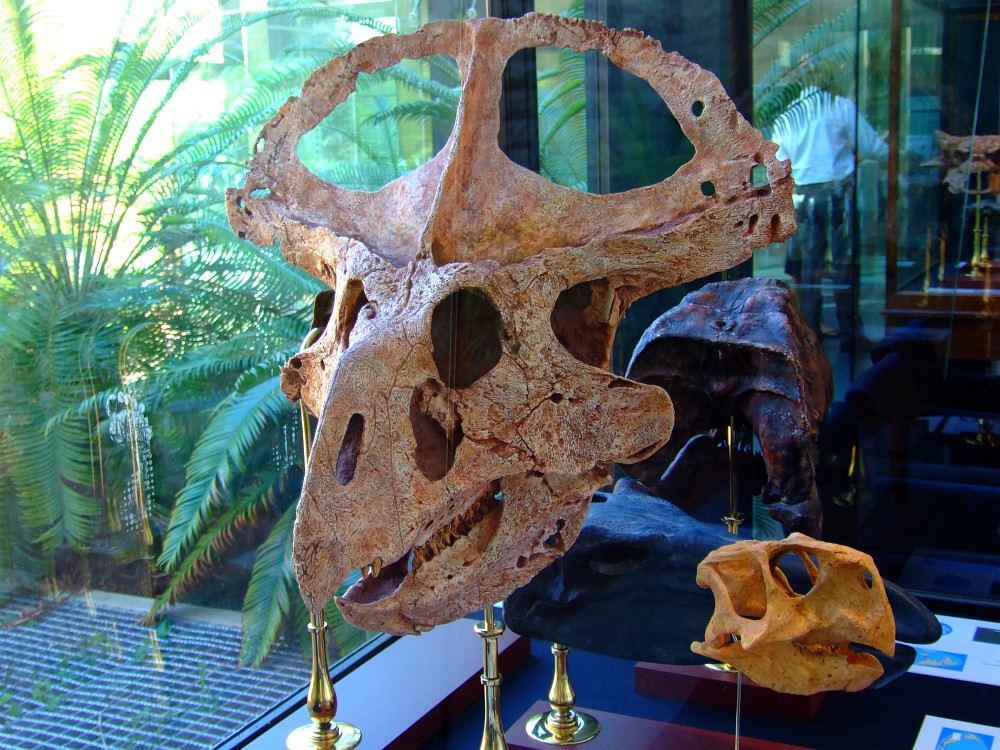
Palaeontology week at the South Australian Museum of Natural History offered some fantastic opportunities to pit oneself against a slippery opponent: glass. The exhibits are all behind (or under) glass, of course ... and it's daylight, which means that trying to get a good photo of an amazing fossil entails finding some way to get the "glare" out of the shot! You can find yourself taking an excellent portrait -- of the photographer, reflected in the glass. There's no real trick to it, but there's a few guidelines to follow, if you're wondering how in the world to get a usable shot. First: observe. Use your eyes. Don't let your brain merely "tune out" the reflections -- see them! Second: use your feet and knees. Move around and duck down, till the reflections are either minimal, or gone. The camera might try to focus on the glass itself, so be vigilant ... make sure it focuses where you want it to. Lastly, the light levels will be low, so set your virtual film speed at 800 or higher, if you're working in Manual mode; and if you're working in Auto mode, take a great number of shots till the camera gives you exactly what you want -- and erase the dross! Photo by Mel, 2009. (Palaeontology Week, late March 2009; in the foyer of the SA Museum. The major skull in the case is Protoceratops.)

Friday, March 27, 2009

Stone Bones


Click image to view at 800 pixels wide

Big things can be difficult to frame, hard to hold focus on, and lighting can change across their area. This is the famous Diplodocus longus skeleton at the British Museum (Natural History), one of those distributed by the philanthropist Andrew Carnegie, based on a specimen from Sheep Creek, Wyoming, unearthed by the collector Barnum Brown in 1901 (if I remember my palaeontology trivia correctly!) I visited the museum in December 2006 and was amazed to find that photography for personal use was as welcome among the great collections as in any other English museum (it's not in Australia!) I took dozens of frames around this 80+ foot animal, from every perspective, and it was far from easy to get an overall image of the critter. Closeups on various bits and from unusual perspectives, but a single view of the whole beast? I walked around it for fifteen minutes, framing and adjusting and snapping. The light was also a little soft, necessitating a long exposure, thus the sharpness of this shot is important too: note the burning-out of the tall windows at the back and the blur of the man walking in the frame. Fuji FinePix S5600, automatic. Image by Mike.

Sunday, February 8, 2009

Echoes of colonial days

colonial-echoes
(You are viewing this image at full size, 600 pixels wide.)

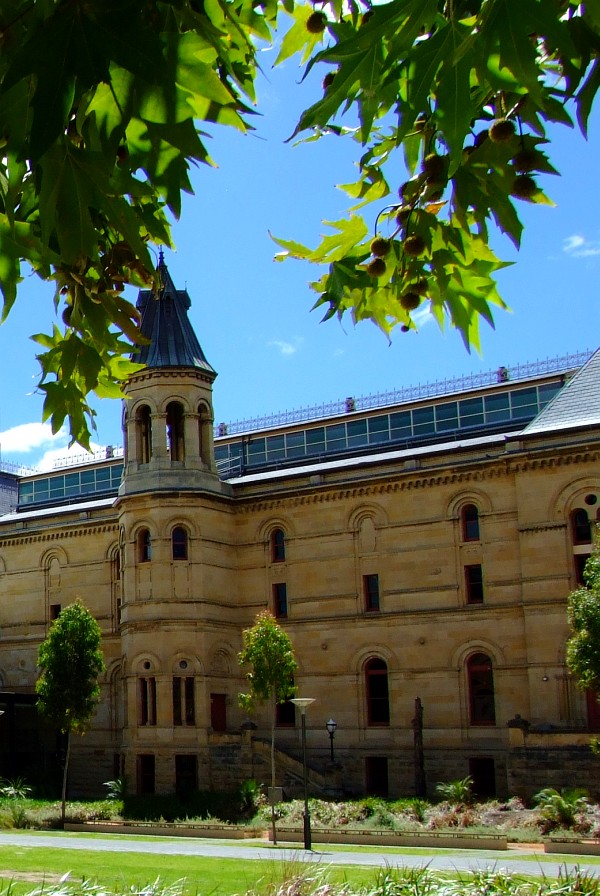
The architecture is still pretending this is the nineteenth century, and with those colors, that tropical brilliance, this would have to be a scene in "the colonies" -- right? Actually, it's the South Australian Museum building on a hot, bright day in February, but almost every part of this shot could just as easily be some location in India, circa 1890! The shot was easy to get, tricky to enhance: the challenge was to get detail to show through in the darker areas and yet not wash out the brilliant blue of the sky. Photo by Mel, 2008.

Monday, February 2, 2009

Mobile artwork

mobile-artwork
Click here to see the entire image at 1000 pixels wide.

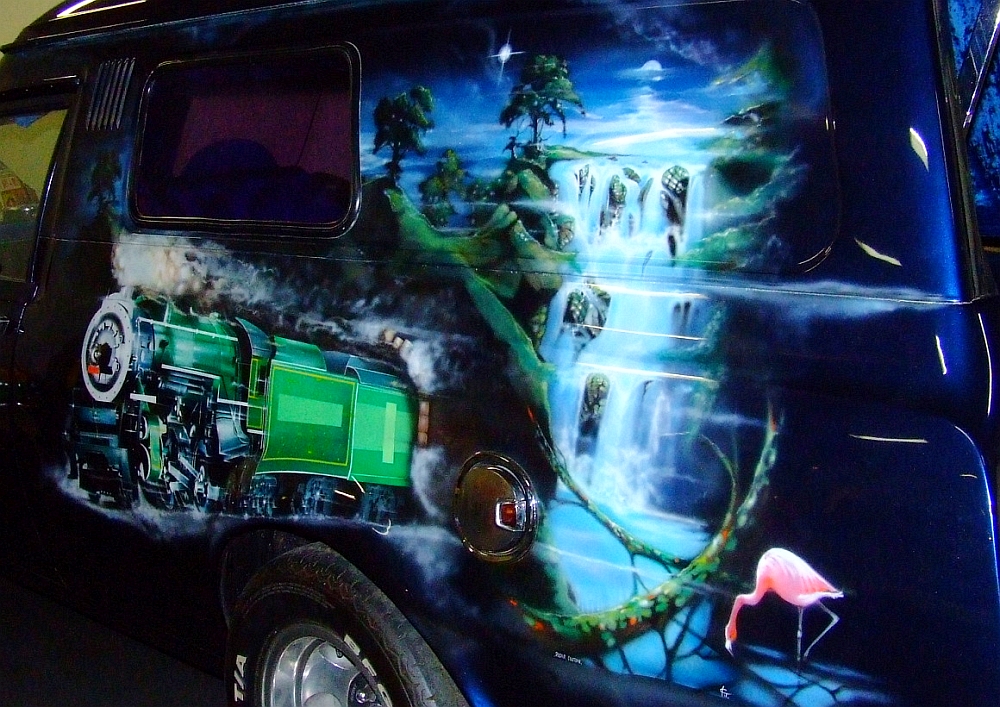
Getting this picture was an absolute nightmare, because the vehicle is standing in lighting conditions which are virtually dark. It's a 1970s panel van -- they were tremendously popular with late teens and early twenties in those days; you'd see them on the beach. Now? The best specimens are in museums! This one is in the National Motor Museum, in Birdwood, South Australia. It's a beauty ... the airbrush art is classic. Brings back a lot of memories! But getting the photo was a major headache, because it was so dark. If you popped the flash, everything would be a mass of glare, with glass and chrome reflecting like mirrors. The answer? A long exposure. When you're walking around a museum, you don't go armed with a tripod! Photography is welcome there, but I think they'd draw the line at people fronting up with a load of professional gear. The solution was to sit the camera on the hood (or bonnet, if you're an Aussie) of a nearby vehicle and trip the shutter gently. The photo still needed a bit of digital enhancement ... but here it is! Photo by Mel, 2006.

Friday, January 23, 2009

A snapshot of prehistory

trilobite
(You're viewing this image at full size.)

This was an exercise in steady hands -- the light conditions were very low -- and, later, in digital enhancement. The trilobite lives at the Adelaide Natural History Museum, and as with all museums, the light is dim. Photography is allowed, so long as flash is not used and the images are not intended for commercial use -- as in, publication (meaning, books, magazines. I can't imagine why a museum would have a problem with a picture being blogged). The film speed on the Fuji 6500 was set at about 800, and still the shutter speed was looooong. The fossil is also quite small; you're on the borderline of macro photography here. The trick was to hold the camera extremely steady. Later, I adjusted the image for contrast and color saturation, and the result is striking. The fossil is going to be something like 300 million years old -- all the trilobites perished in the great extinction 250 million years ago. This one is beautifully preserved. Photo by Jade, 2008.

Wednesday, January 21, 2009

A Case for Filmspeed Adjustment...


Click image to view at 800 pixels wide

My UK trip in late 2006 was my first really major digital foray, at least with an up to date camera with sophisticated capabilities. I wasn't clear on many of the functions and had heard all sorts of conflicting stories about just how digital photography compared and contrasted with the physical age. Show me a Pentax K1000 and a roll of film, and I'll make it sit up and talk... "Virtual grain" was a concept I was worried about, and preferred to minimise motion than risk resolution damage, especially as I was looking to cram as many shots as possible onto my flashcards and was shooting at only 2mp to start with. This shot was taken at the RAF Museum, Hendon, in the northern suburbs of London, in early December '06. You might think that so many lights glaring off polished aluminium would make for ample illumination, but not so: with a filmspeed of 200 selected, to increase light gain but still stay safely in the fine-grain range, the camera was on the verge of motion problems all the time. I started using steadying supports -- beams, railings, anything. In this shot of the B-17G, the camera is on top of a post in the walkway fence -- see it snaking toward the POV at left? Don't even ask about flash, the FinePix S5600's flash wouldn't reach as far as the propellers. Of course, it turns out I could have raised the filmspeed by a factor of four before encountering virtual grain, but I didn't know that at the time... Photo by Mike, 2006.