Showing posts with label low light photography. Show all posts

Thursday, April 9, 2026

Workhorse of the Sea


There is something majestic about ships, and maritime towns always make for interesting shooting locations. I grabbed this shot on November 8th, 2012, from the deck of the South Shields ferry, crossing the River Tyne on my way back to Roker after an excursion to Tynemouth Castle and Priory. This is a DFDS Seaways vessel preparing to leave in the evening for its overnight run to Amsterdam. It’s fascinating to be able to see into the open vehicle deck. I’ve often wondered what a crossing would be like on such a ship, a marvelous start to a holiday with one’s car in the hold. This frame is fairly unique as, given the exposure rating of the cameras of the day, I had limited ability to control for low light, The evening was coming in fast, and while the chip handled low light beautifully, it couldn’t compensate for motion with reduced exposure time. I shot plenty of frames, but this is the one where it all came together, and wasn’t blurred by motion. Fun memories, I miss those trips! Minor adjustments to colour, contrast and sharpness in Irfanview; Fuji FinePix S5600. Image by Mike.

Sunday, November 16, 2025

Looking Back a Hundred Years

Here is an interesting scene—a British railway platform, c. 1920s, as recreated in meticulous detail in the National Railway Museum, York. Here one steps back a century—no digital screens, no neon lights, nothing post-dating the era of steam and newspapers. This is the world of P G Wodehouse and Agatha Christie, when movies were silent and radio a novelty. This is the genius of the museum scenario, a kind of immersion in which you can look into another time. The light levels in the museum are quite soft, so I was holding the camera against a vertical surface for stability, and did quite well—the light gathering ability of the old technology was only a fraction of today’s point-and-shoot ability. Supporting the camera during long exposures became second nature. I took this shot on my UK trip of November, 2011, the last time I visited the NRW, and it certainly appeals to my fascination with vanish point symmetry. Minor adjustments to contrast and sharpness in Irfanview; Fuji FinePix S5600. Image by Mike.


Saturday, May 17, 2025

Fun with Low Light

This is another of the group I took when leaving England in 2010. This is at the very doors of the Heathrow Terminal, looking across the arrivals area, and just before they turned on the purple neon (find that in an older post). Notice the steel anti-ram-raider bollards—I think I rested the camera on top of one of them to stabilise it. In the previous frame a moving vehicle is blurred, telling you how long the shutter was open, while in this one nothing was moving, creating this beautifully textured, nuanced image. The only adjustment I made is a tiny touch of sharpening, otherwise this is exactly as the chip read the moment. This was November 16th, 2010, and I was glad to be heading home, as I had been quite unwell on this expedition. Fuji FinePix S5600. Image by Mike.


Tuesday, April 29, 2025

Full Moon Rising


A full moon rising over an Australian city, but the trees give it a bush feel. I took this pic from the upstairs balcony of our last house, on July 14th 2011. A lot of water has gone under the bridge since then! It was nice to have an upstairs (it was nice to have a swimming pool...) and occasionally there were photo ops without leaving home. This is an interesting pic, not for the moon but foe the trees. The sun is just down and the evening light still enough to front-light the trunks, which gives a very pleasing effect, The moon is a burned out disc, which is to be expected at the kind of exposure needed to register the trees in detail. It must also have been a very still evening, because the lens would have been open a while, yet the leaves have not blurred. Minor adjustments to colour, contrast and sharpness in Irfanview; Fuji FinePix S5600. Image by Mike.

Thursday, January 23, 2025

The Dark Capture Lottery


To an old chip, low light could be the kiss of death. But, in a way, the new super-fast light-gathering digital cameras have taken some of the trickery out of it, because it used to be very creative—trying to accommodate a long shutter speed in low light without blurring the shot. Now you can point and shoot at thousands of ISO (ASA as film speed was rated in the old days), without incurring unacceptable digital grain, but a decade and a half ago it was not so easy. This is the Georgian Crescent in Whitby (the hotel where Bram Stoker wrote Dracula may actually be in this picture!), the night before I set out for home at the end of my November, 2011 trip. I took a wander around the town with my camera to see what I could catch. Light on the river, street lights, street scenes—but all hampered by the light gathering ability of the reliable (old) camera. I’m unsure exactly how I got this one to come out sharp—I may have balanced it against a street lamp or other vertical post. If it was hand-held then it was simply luck that I didn’t move while the shutter was open. But by this point in my travels it was second nature to support the camera against something solid to prevent movement when shooting in the gloom. Minor adjustments were made in Irfanview. Fuji FinePix S5600. Image by Mike.


Monday, October 9, 2023

Morning Trade


An interesting exercise in holding the camera steady for opportunistic shooting: this is London's Paddington Station, about 6 in the morning of Sunday, October 31st, 2010. I had just got off the Heathrow Express, after a 4.50 arrival from Australia via Singapore. It was much too early to be making my way to my hotel, so I killed time around the station, got a bite at a small cafe and just watched the morning traffic as daybreak unfolded. I have another frame showing a clock, snapped at 6.45. Here the place is floodlit but essentially deserted, and I was shooting hand-held. Normally I would look for something to support the camera on with light levels like these, but they were just on the balance point of being high enough, and I was far from well on the 2010 trip, so not being fancy. I held the camera quite appreciably steady, I think! There are nice symmetries in the architecture (by the great Brunel). The picture was squared up with fine rotation, colour and contrast were enhanced and there was some minor gamma correction and sharpening. Fuji FinePix S5600, automatic. Image by Mike.


Tuesday, September 8, 2009

Busy Airport


Click image to view at 1000 pixels wide

This was a simple enough shot, but compsition was the object, looking for a frame filled with machines and the implicit action of people interacting with them. Flights were arriving and deplaning at Newcastle Aiport, UK, this evening in November, 2007, and while I waited for my own connection to London I amused myself shooting through plate glass, defeating reflections by easing behind a standing display of some sort, and using telephoto to close on the subject matter. As evening drew toward night I held the lens surround hard against the glass to control shake. Here a row of Boeing 737s was marshalled at the arrival terminals, and handlers were busy with their offloading and replenishment. The usual enhancements were done; Fuji FinePix S5600, automatic, telephoto. Image by Mike.

Saturday, September 5, 2009

Beachhouse at Dusk


Click image to view at 1000 pixels wide

The light levels must have been very much 'in the cracks' between what was possible for daytime photography and the restrictions for a nighttime shoot. I caught this soft study of a house on the Brighton foreshore, southwest of Adelaide, SA, in spring, 2007, between sunset and moonrise, and the chip registered the pastel tones of the cool light wonderfully well. The frame was sharpened and very carefully balanced for colour and contrast, so as not to rob it of its original feel. Fuji FinePix S5600, automatic. Image by Mike.

Monday, August 24, 2009

Available Light, With a Difference


Click image to view at 1000 pixels wide

This is the British Museum's mounted skeleton of the dinosaur Baryonyx walkeri, photographed in December, 2006, and it presented a different lighting situation to most other displays. The floodlights built into the mount provided all the primary illumination, whereas most of the freestanding dinosaurs are in mysterious, soft lighting and are so large that flash shots tend toward the indistinct as the subject flows into the background in ways contrary to the usual performance of flash. This is a non-flash shot and the contrast level is excellent. The frame was sharpened and colour-enhanced. Fuji FinePix S5600, automatic. Image by Mike.

Monday, August 17, 2009

Soft Dusk Light


This is one of my Newcastle Airport shots from November, 2007, taken with the camera held firmly against plate glass and with the benefit of a piece of furniture blocking reflections. The sun was down, leaving the world in indirect, long-frequency light, and so long as the camera was steady the chip translated the conditions remarkably well. I framed the standing aircraft and waited for the taxying aircraft to reach the right point in the composition before releasing the shutter, compensating also for the timelag in that operation. Sharpened and contrast-balanced. Fuji FinePix S5600, automatic, telephoto. Image by Mike.

Wednesday, August 12, 2009

Metal and Complex Light


Click image to view at 1000 pixels wide

Here the POV is under the tail of the DeHavilland Sea Venom at the Fast Jets Fighter Museum, Parafield Airport, north of Adelaide, taken in January, 2007, and the range of tonal values the chip has gathered are striking. The shadow areas have been adequately registered, while the main lighting source is burned out, yet the general colours of the environment have been captured with great truth. The image was sharpened, and the colour and contrast adjusted slightly. Fuji FinePix S5600, automatic. Image by Mike.

Street Scene in Shadow


Click image to view at 1000 pixels wide

This frame was taken in the morning at the top of the eighteenth-century Henrietta St, Whitby, in November, 2007. The shadow of the east cliff is cast over the mouth of the River Esk and flattens the contrast, and this frame, looking back down the steep street, catches the compression of perspective with a medium telephoto factor. The verticals of the buildings become the theme, and the horizontal of the road surface the element giving meaning to the verticals. The absence of pedestrians creates an almost staged air, and a quite artistic feel. Sharpened and contrast- and colour-balanced. Fuji FinePix S5600, automatic, telephoto. Image by Mike.

Friday, June 12, 2009

Slow Burn Image


Click image to view at 1000 pixels wide

Having experimented with faster virtual filmspeeds and encountered 'digital grain' in the 800 ASA range, I'm actually glad I stayed with 200 ASA and played the camera-motion game at my shoot at the RAF Museum, Hendon, in December, 2006. This is their Lancaster bomber and shooting a black aeroplane in a huge building in which the lumens were never quite right for photography was a technical challenge, but the clarity and liquid-smoothness of the 5mp image were in fact worth it. I saw a photo taken at the Lancaster assembly line during WWII, an early colour negative, with a filmspeed so slow you could see the ghost-images of technicians who were walking through the frame. To my amazement, the same thing appeared in this shot: note the patron at far right. This tells you how long the exposure was. The camera was held solidly against a column to eliminate motion, then the chip simply did its thing with the exposure, rendering a very pleasing final result. Sharpness and colour were enhanced. Fuji FinePix S5600, automatic. Image by Mike.

Sunday, April 19, 2009

Reflections

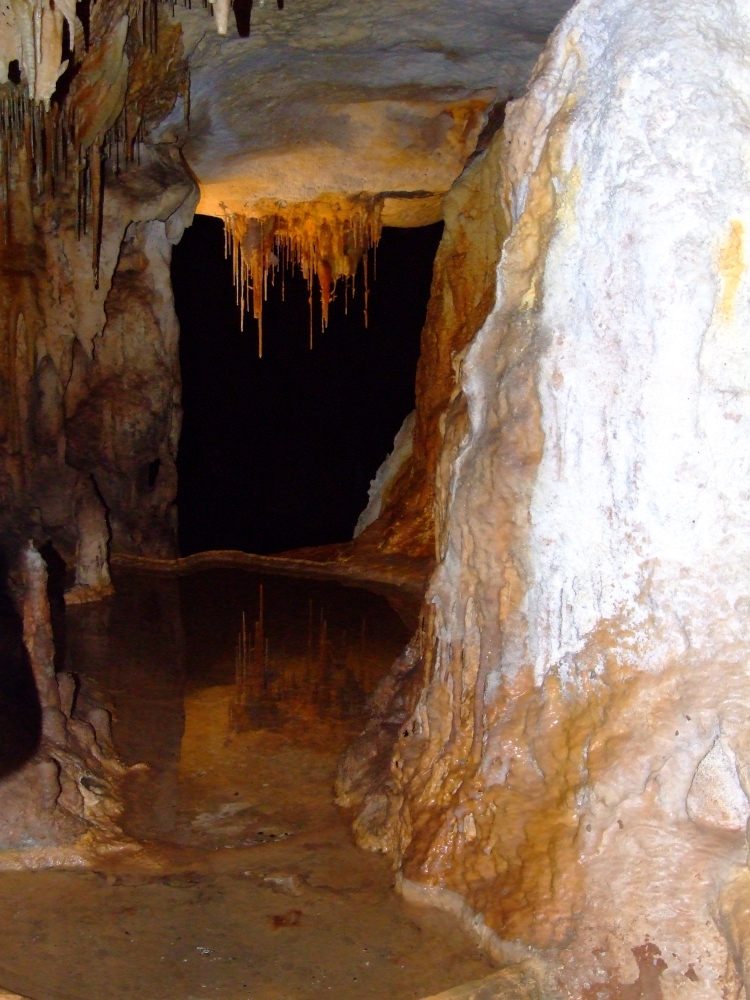
alexandracaveWP092

This is a reflecting pool. You are now about 15 metres underground in the Alexandra Cave at Naracoorte. The water depth is between 1 to 3 centimeters. In order to get the natural colours of the calcite flowstone to show properly, you need to be at least 10 feet away, a masked flash, and a good zoom. Very difficult shot, but if you know how to mask the flash then it should come out right. Don't worry about the pool drying out, the cave's humidity is 98%.photo by dave

The Ruins of Trinity Church


Click image to view at 1000 pixels wide

Backlight from a low sun through a stormy cloudbank creates a highly atmospheric backdrop to this burned-out church. It was a creepy experience to get this batch of photos on an afternoon in November, 2006, in Stockton-on-Tees, Yorkshire, UK. This is Trinity Church, burned by vandals in 1987 and left standing as a reminder of senseless destruction. A local icon hundreds of years old, it has gone from a community focus to one of England's ecclesiastical ruins, featured in the folklore of the North-east for the tree which stands by its door, reputed to be the mortal body of a witch who shape-shifted to escape a mob who had chased her to a sanctuary she was denied. They tried to burn the tree, but found it would not burn. Ironically, hundreds of years later, though the church went up in smoke, the tree still refused to burn! The light level was low, to expose the stonework the sky has burned out, creating a sense of Gothic unease which pervades the ruin on all but the sunniest days. Enhancements were mild as always, colour and sharpness, preserving the sense of the original. Fuji FinePix S5600, automatic. Image by Mike.

Saturday, April 11, 2009

Lights on the River


Click image to view at 800 pixels wide

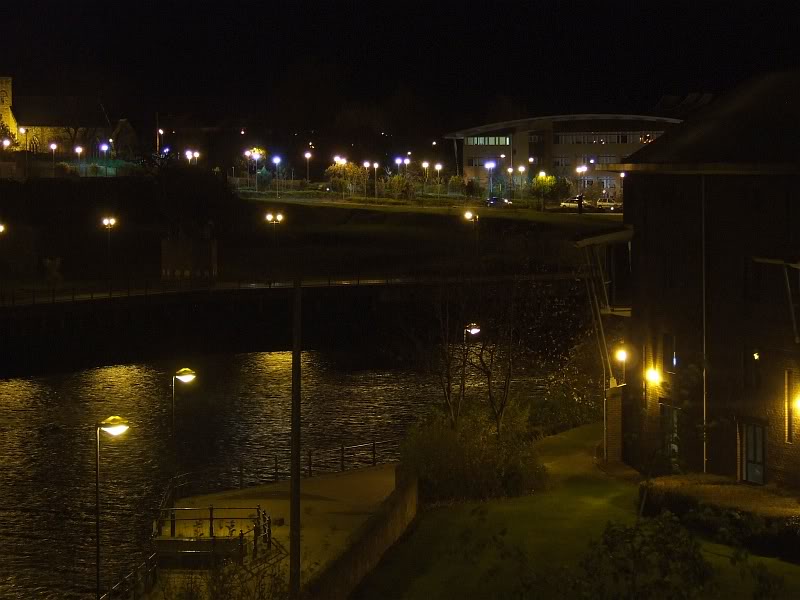
This is the River Wear in Sunderland, in the stretch just beyond the Wearmouth Bridge, looking across to the St Peters Campus of the University of Sunderland. At top left is the church of St Peter and St Cuthbert, on the site of a church where the Venerable Bede was based in the 7th century. It was about 10 at night, and very cold in mid-November, 2007, and I shot several frames on my walk from a dinner at the Bonded Warehouse (now a trendy venue on the south side) back to my boarding house by the Roker seafront. The streetlighting was quite strong enough for me to be hopeful that a supported camera would get the goods, and it did. A handrail provided a firm footing for this shot. At least three frames were good enough to be shortlisted for the blog, and this one has the most interesting subject matter. Enhancements include sharpness, colour and a tiny bit of contrast, otherwise this is a verbatim example of night photography -- what the camera can see that the eye on the night might not, at least not consciously. Fuji FinePix S5600, automatic. Image by Mike.

Wednesday, April 8, 2009

Classic Backlight with Foreground Illumination


Click image to view at 800 pixels wide

The long row of windows along one side of the first display hall at the RAF Museum, Hendon, in northern London, made for tricky lighting throughout, as the natural light of a drizzly, grey day vied with the artificial lighting inside. This shot of their immaculate Mustang was taken from the mezzanine gallery on the opposite side of the hall, shooting under the nose of their suspended lifesize mockup of the Eurofighter, and I was mildly amazed that everything balanced out properly. The exposure was comparatively long, the overcast afternoon completely burned out the windows, but, remarkably, the school kids at bottom right were moving little enough not to blur. The ring of lights under the plane have registered amazingly well, making this a delightful play of light and reflection. The camera was solidly supported on a handrail. Enhancements include sharpness, contrast and colour. Fuji FinePix S5600, automatic, telephoto; December, 2006. Image by Mike.

Monday, April 6, 2009

Cafe culture goes way upmarket

national-wine-centre
Click here to view entire image at 1000 pixels wide

Low-light photography offers a whole suite of challenges in either optical or digital, and your solutions to these tests might be different on different days (or shoots). It all depends what results you want: the pro might want a tack-sharp image without grain, because s/he is more than likely shooting for a brochure. The amateur will want a good, clear shot, and can afford to live with a little grain, since the image isn't going to be published, much less at large size. Either way, your choices (your solutions to the challenges) will define this project: stop the action, or "correctly expose" the background, produce fantastic depth-of-field with blurred figures, or accept a little grain in the shot...? It's all about film speed, aperture, and shutter speed. Here's a few ground rules to help you make the decision: high shutter speeds will stop the action (no blurry figures), but you'll need either (or both) bigger apertures or faster film speed to get those fast shutter speeds. Big apertures cost you depth of field, and fast film speeds give you grainy images. Long shutter speeds give you blurry figures (anything that might be moving), plus the probability that you'll get "camera shake" during the exposure, which means the whole shot is blurry. Somewhere among all those "downsides" is a happy medium, and depending on what you need or want out of the finished shot, you'll make your decision. Photo by Mel, 2009. (The National Wine Centre, Adelaide, South Australia.)

Friday, April 3, 2009

Fossils, front and center!

paleontology-week
Click here to view at 1000 pixels wide.

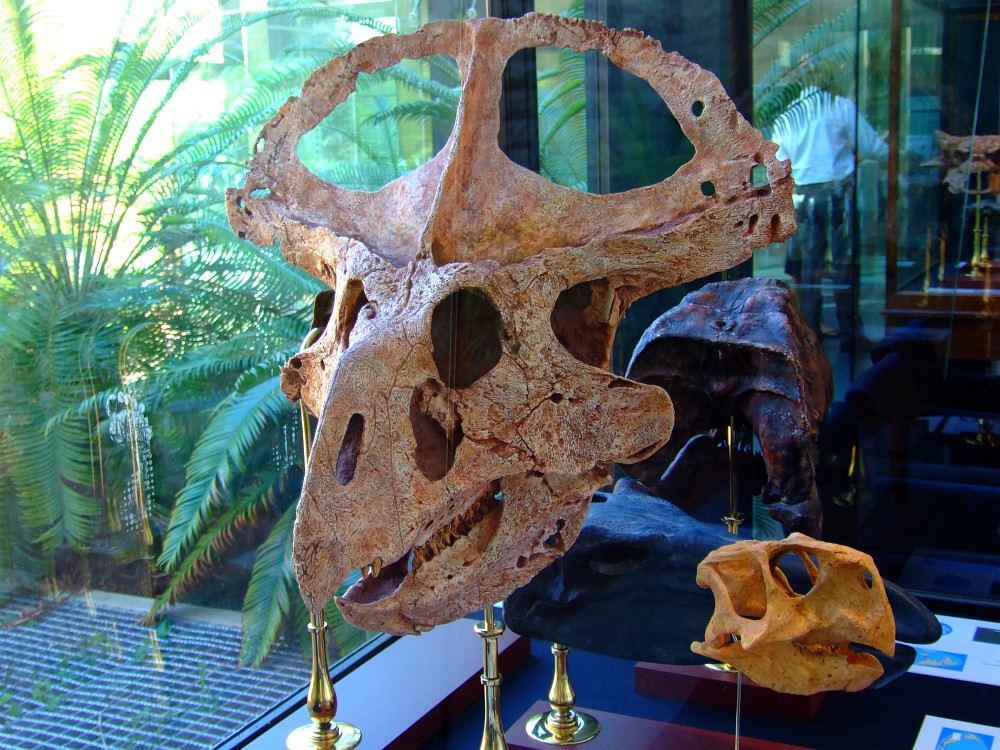
Palaeontology week at the South Australian Museum of Natural History offered some fantastic opportunities to pit oneself against a slippery opponent: glass. The exhibits are all behind (or under) glass, of course ... and it's daylight, which means that trying to get a good photo of an amazing fossil entails finding some way to get the "glare" out of the shot! You can find yourself taking an excellent portrait -- of the photographer, reflected in the glass. There's no real trick to it, but there's a few guidelines to follow, if you're wondering how in the world to get a usable shot. First: observe. Use your eyes. Don't let your brain merely "tune out" the reflections -- see them! Second: use your feet and knees. Move around and duck down, till the reflections are either minimal, or gone. The camera might try to focus on the glass itself, so be vigilant ... make sure it focuses where you want it to. Lastly, the light levels will be low, so set your virtual film speed at 800 or higher, if you're working in Manual mode; and if you're working in Auto mode, take a great number of shots till the camera gives you exactly what you want -- and erase the dross! Photo by Mel, 2009. (Palaeontology Week, late March 2009; in the foyer of the SA Museum. The major skull in the case is Protoceratops.)

Monday, March 30, 2009

A Dizzying Perspective


Click image to view at 800 pixels wide

The escalators up and down to London tube stations (the "Underground") are extremely steep. You really have to hold tight to your baggage and the handrail because in the long glide, especially when moving, and looking, upward, you can lose your orientation. An indication of how steep they are, and of how far off-true your middle-ear can take you, is the orientation of the show posters that line the walls. They are genuinely upright, everything else is skewed! You can also get a sense for how low the lighting is, as the escalator and the people on it are in focus as they are moving relatively the least, while the walls are soft as they move by during the exposure time. A simple framing job, I shot one-handed while holding the rail. The normal sharpen, contrast and colour tweak were applied. Fuji FInePix S5600, automatic; December, 2006. Image by Mike.