Showing posts with label birds. Show all posts

Tuesday, December 31, 2024

How to Cheat at Wildlife Photography


Since when have I been a birding photographer? That’s my sister’s province, and I wouldn’t dream of trying it! But this was a little different. This pic was taken at Warrawong Wildlife Sanctuary in the Adelaide Hills, on October 31st, 2018, during an afternoon visit, and those who have been there will know how it came about. The restaurant has a long wall of plate glass looking into a protected garden where the birds come to feeders, and if you’re a fair hand with zoom and framing, you can grab studies like this from your seat. The chip handled the lighting conditions wonderfully. Cheating, yes, but I was not going to turn down the chance of a pic like this when the birds were barely three metres from me, and sitting still to be photographed! This picture was mot enhanced in any way. Fuji FinePix S5600. Image by Mike.

Happy New Year’s Eve!

Friday, August 23, 2024

Gulls on Painted Water

I love shooting reflections, and sometimes, when you close in on a reflective surface to exclude the ‘real world’ source material of the reflection, the result can become abstract art. Here are seagulls on the placid waters of Whitby harbour, Yorkshire, England, photographed on Sunday, November 7th, 2010. I had taken a long stroll around town in the afternoon, visited the abbey on the headland, and would soon be shooting the lights after dark, but here the ambient conditions were suspended near the end of day, and the waters picked up this artsy look—almost like an illustration coloured in. Minor-adjustments to contrast and colour only. Fuji FinePix S5600. Image by Mike.

Sunday, September 27, 2009

A Winter's Afternoon


Click image to view at 1000 pixels wide


The low sun tells you how far north Stockton, Cleveland, UK, is: this was early afternoon and the sun is behind the trees of Ropner Park, whose skeletal boughs reflect the early December date and the fact they will be covered with snow very soon. It was a raw day in winter, 2006, filled with dramatic light and colour, the sort of photographic opportunities that are perhaps rarer in Australia. Sharpened and contrast-balanced, and, stark as this image is, extra colour was added. Fuji FinePix S5600, automatic. Image by Mike.

Thursday, August 20, 2009

Waterbirds in Grey Light


Click image to view at 1000 pixels wide

These swans were photographed on the lake at Ropner Park, Stockton, Cleveland, UK, in December, 2006. It was a day of changeable weather, alternately grey or sunny, rainy or dry. The birds on the lake, ducks, swans, geese, are expert wranglers for food and flock to any visitors. They make unusual photographic subjects, especially in the quite steely light of the moment. This shot was cropped from a larger frame, sharpened and the colour enhanced slightly. Fuji FinePix S5600, automatic. Image by Mike.

Tuesday, August 4, 2009

Urban Visitor


Click image to view at 1000 pixels wide

Seagulls penetrate to the heart of London, reminding the viewer that the Thames, so wide and placid and dirty, is in fact a tidal river and that the arm of the sea known as the Thames Estuary is not very far to the east. This bird posed for a telephoto portrait on a (fascinatingly textured) rotted wharf piling on the river frontage near the Tower of London, with the old cruiser HMS Belfast framed as the background, in November, 2007. Sharpened and colour- and contrast-balanced. Fuji FinePix S5600, automatic. Image by Mike.

Saturday, June 13, 2009

Light Through Quartz and Feathers


Click image to view at 1000 pixels wide

Australian seagulls are small grey and white birds that are seriously human-habituated. They beg for food whenever they see a human, and will always tidy up fast food abandoned on the sea front. I took this shot not long before sundown in the spring of 2007, and the low-angle, short-frequency light has created some interesting effects. The point that draws the eye is the sun shining through the wind-ruffled feather, then the refraction through quartz grains in the sand, while overall the play of short-frequency light in the highlights and long-frequency in the shadows creates an almost painting-like texture. Sharpened and colour-enhanced for publication. Fuji FinePix S5600, automatic. Image by Mike.

Saturday, April 11, 2009

Noisy Miner

australian miner bird


This bloke is called a Noisy Miner. It's a type of honey-eater. They normally don't let you get too close, but I was able to get about 5 feet away from him/her. I was concerned that the miner would fly away so I just left the Fuji 6500 on auto. Took about 20 quick shots before s/he flew away, and this one turned out the best of all. Gotta love filmless photography! photo by dave

Monday, April 6, 2009

MY branch!

MY branch,


If you don't have a widescreen monitor and would like to see the 1000 pixel wide shot, then just click right here.

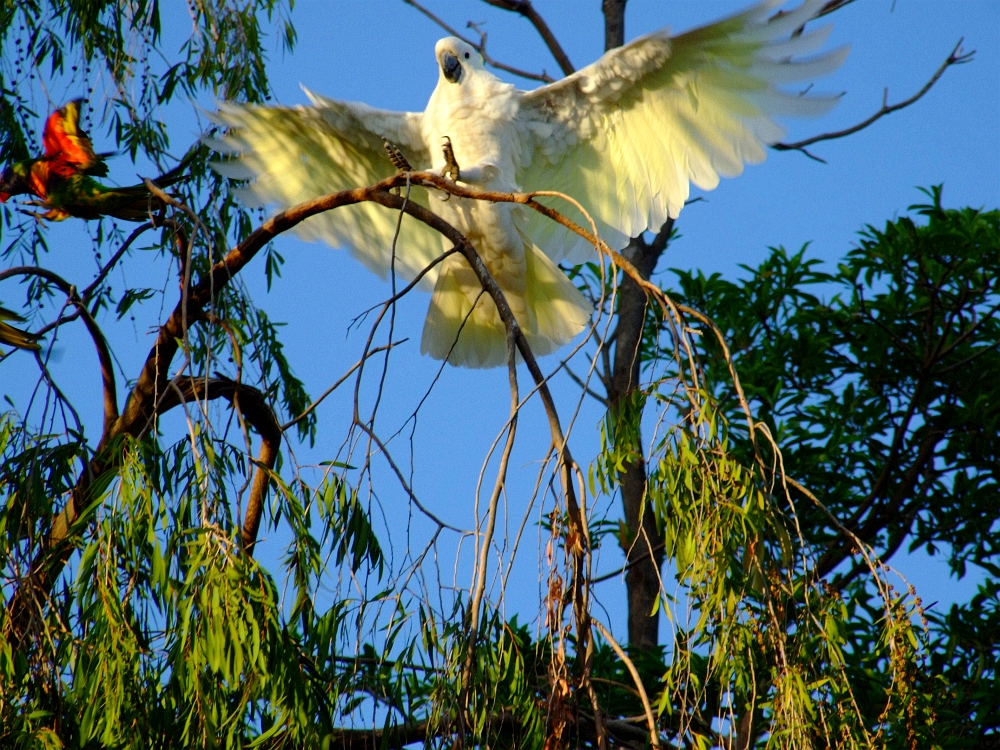
I do like to take parrot pictures. Maybe because there are so many wild ones around here and I never saw them back in Alaska. This was taken early in the morning and the sun was just up. The sun was shining directly at the landing cockatoo. I was actually taking pictures of the little rainbow lorikeet that's flying away and tripped the shutter right after this big bloke jumped from a branch about 3 feet behind this one. Guess he just really wanted his picture taken. the Fuji S6500fd does quite good work in these conditions, and I didn't even have the shutter set for high speed pictures. It was manual focus, but everything else was on automatics, and no colour fixing was down in the computer. Very handy camera. Photo by dave.

Thursday, February 19, 2009

The Darkening Sea


Click image to view at 800 pixels wide

There's something so primal about the sea. Any sea is primal, but it's easy to be comfortable on a bright beach, or under a clear sea with coral-grown shallows under your flippers. It's a cold, hard sea that reminds you the ocean is a very different world to the one we evolved to live in. This was Whitby harbour's breakwaters at twilight, November 2006, under a biting wind. The sun was gone and we're looking more or less north over the North Sea. Scandinavia lies out beyond that horizon, and the falling dusk and restless energy of the cold sea feel hostile to humans. Yet it's where the birds live, and this shot captured that essence: the herring gulls, the big, dusky seabirds that haunt the quays waiting for the fishing fleet to return, are the survivors of the coast, and here they are seen in their evening flight before settling for the dark hours. I took audio recordings of their unique, sweet cries, and was amazed that this image registered their flight so clearly. With the falling light I expected them to blur, but they are clear as daylight. The picture was slightly digitally enhanced for publication. Fuji FinePix S5600, automatic, telephoto. Image by Mike.

Monday, February 9, 2009

Black swans cruising

black-swans
Click here to view the entire image at 1000 pixels wide.

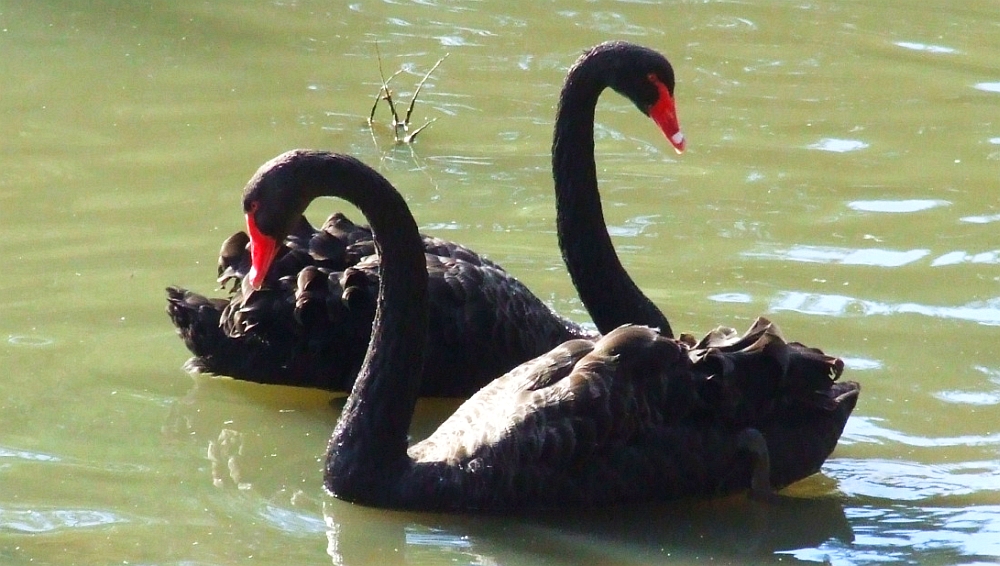
Australia -- being on the other side of the globe (and therefore upside down, from the standpoint of, say, London or new York!) tends to do things backwards. For instance, the trees don't shed their leaves ... they shed their bark. The flowers don't bloom in summer ... they bloom in winter. And the swans aren't white -- you guessed. They're black. These particular swans are cruising the somewhat murky waters of a natural lake at a campsite in the Barossa, and were photographed early one morning in 2006. They're a mated pair, and their cygnet is just out of the shot, to your right. The signs were up: beware of swans. They can be violent and quite dangerous in the breeding season, if they perceive their offspring to be under threat. These birds seemed peaceable enough. Photo by Mel, 2006.

Sunday, February 8, 2009

Sometimes you get lucky

lorikeet landing

I do apologise for the grainyness of this shot, but what a pose! I had just started playing with the "sport" mode on the Fuji S6500fd so I wasn't sure how well it would work in low light conditions. It was a cloudy morning and the sun was just up. The rainbow lorikeets were being very active on the feeder so I zoomed in on the feeder, pre-focused on it, set the camera to "sport" mode in the scene select, and then held down the shutter on continuous mode for about 30 seconds while holding the camera steady. Photo by dave

Tuesday, February 3, 2009

Quick Fix

Let's say you've taken a picture which would be GREAT. The focus is spot on, no camera jitters, beaut! Except for the fact you had to take the shot quickly (no time to go to manual settings on your wonderful digital camera), and the annoying fact that the sun was right in front of you.

Say, perhaps something like this:
DSCF5300


No worries though, cus in one or two mouse clicks it can look like this:
fixed


The fix is done using Irfanview, a free and awesome imaging program. All I did was turn the gamma from 1.00 to 1.48, the contrast from 0 to 25 and two clicks of sharpness (I set each click for a value of 2%).

You can do a lot with Irfanview, give it a go and experiment.

Photo and enhancement by dave.

Sunday, February 1, 2009

The migrant turtle dove

turtle-dove
Click here to see the whole image at 1000 pixels wide.

Turtle doves are found all over Australia -- they're one of Mama Nature's greatest survivors. They can stand the weather (both summer and winter), and they eat ... well, everything. In fact, they're so prolific and numerous, it comes as a surprise when you learn that they're not native to the country. In fact, they originated in India, and would have come to Australia with migrants, probably some time in the late 19th century ... and I have a feeling it would have been British migrants who were partial to pigeon pie! This is a telephoto shot at6MP, cropped at top and bottom, and resized. I didn't touch the color or contrast, but I did tweak the color saturation a tiny bit. The camera was the Fuji 6500, which is great at capturing birds that are not too far away, and/or not too small -- it has a 10:1 optical zoom, and the 6MP feature gives you plenty to crop into. Photo by Jade, 2007.

Monday, January 19, 2009

View From The Trees

there is russia


The galah is a very common parrot down here in Australia. It is called a Rose-Breasted Cockatoo outside of Aus, but down here (where it comes from) we just call it a galah. They are very playful birds, especially the young ones. They have a loud cheep and an even louder screech when they are trying to act tough. But nothing like the Sulfur's ultra loud squawk though.

This bloke was about 15 feet up a tree, the Fuji S6500fd was on full manual zoom and the camera settings were for full automatics. I just let the camera do all the work and it did it brilliantly. Photo by dave

Saturday, January 10, 2009

Lorikeets: breakfast for two, please!

Click on the pic to view at large size.

Every morning, flocks of Australian parrots show up for breakfast at my bird feeders. I get cockatoos, lorikeets, galahs, little corellas, the occasional long billed corella ... plus the usual turtle doves, native crested pigeons, magpie larks, honey eaters, wattle birds, sometimes a wagtail, and a couple of kind of ducks will make a splashdown in the pool. The morning light is a great opportunity for picture-taking, and lorikeets are so photogenic. They're so colorful. You need to be quick with the camera, and digital cameras don't do this kind of photography so well on automatics. You're better off if you go to manual exposure and manual focus. The shot above was pre-focused on the swinging feeder, and to get the perfect exposure on the birds, a few test-frames were taken. You need a fast shutter speed to capture these little buggers: they're quick and they don't stay still for long! Photo by Dave, 2008.

The church of many cockatoos

Strathalbyn-church
Click here to view at 1000 pixels wide.

Church architecture is the same, the world over. Australia was colonized by people from every part of the British Isles. They brought so many things with them -- plants, animals, fashions in clothing and architecture -- that sometimes, in South Australia, you could almost think you were in an English village. Almost. This church is in the country town of Strathalbyn, and is so familiar, with its square tower ... but you know you're not in England. See the big white birds sitting on the gate and in the tree at lower left of the shot? Cockatoos. Thousands of these parrots nest in Strathalbyn, along the river which runs through the park in the middle of the town. Conditions on this day in 2007 were very dim; temperature was ambient to cool, with an thick overcast. This made it difficult to get good, sharp pictures, since apertures were large and shutter speeds correspondingly long. (A little photographic theory goes a long way, and most of what you learned in optical photography is applicable to digital cameras!) Photo by Jade, 2007.

Thursday, January 8, 2009

Watching The Sun Rise

This Sulfur-Crested Cockatoo had the best seat in the house:
cockatoo watching sunrise

The sun was not yet up. It was about twenty minutes before sunrise, and a few cockatoos had arrived in the yard, and all seemed to turn toward the sunrise. I left the camera on full auto -- focus and exposure -- and trusted the Fuji Finepix to handle the difficult lighting conditions ... which it did! The picture has not been enhanced at all -- this is the raw frame, just as it was shot. Photo by dave, October, 2008.