Showing posts with label woods. Show all posts

Thursday, November 13, 2025

Hidden in the Woods

Here’s an example of a reflex shot that turned out just right. It’s a case of seeing the composition and grabbing the shot, just frame and shoot. I snapped this one through the train window on the way to Cardiff on November 21st, 2012. The sunlight striking the vertical building, framed by the green woods behind and the dark, shadowed foreground vegetation works perfectly, and I did not even need to square up the image with fine rotation. It’s pure composition—I have no idea what this building is (a church, by the looks of it) or even where it is, it just works as a pure visual motif. Minor adjustments to colour, contrast and sharpness in Irfanview; Fuji FinePix S5600. Image by Mike.


Thursday, August 8, 2024

Deceptive Woods

Why deceptive? This image excludes anything man-made: one would be forgiven for thinking I was in the depths of a forest when I took this frame, and that’s somewhat true, as the whole region is heavily forested. But there was a town’s main street just behind me. These trees are above the carpark at Aldgate, in the Adelaide Hills, where a walking trail begins, leading a few kilometres to Mylor. The main road, carrying the weight of through-traffic, is below and behind my POV; sun through trees is a favourite theme and composition of mine. This frame was captured on the 15th of April, 2017. Some minor adjustments were made: colour was increased a little, and gamma correction was used to pull out mid-tone detail from the otherwise harsh contrast. Image by Mike.
 

Saturday, February 21, 2009

Strange life forms

tree-fungus
(You are viewing this image at full size, 600 pixels wide."

As the exploration of space begins, and humans begin to travel to planets that are earthlike but still very different, especially genetically, one might expect reports to come home of strange lifeforms, unanticipated and way out of the norm. But ... what's normal anyway? These are tree fungi, and life forms don't come much more weird! The picture is an exercise in capturing depth of field -- this being the amount of the image that's in focus between the lens plane and infinity. The trick is this: the smaller the aperture you can get, the greater the depth of field you can achieve. Now, in low light conditions (like this: the glade was dim and green), to get a small aperture and keep the exposure right, you'll have a long shutter speed. If it's too long to hold the camera steady (preventing camera shake, which blurs the image), see if you can sit the camera on a level surface ... because you'll never have a tripod with you when you need one! Photo by Mel, 2008.

Saturday, February 14, 2009

Lakeside illusions

lakeside-panorama
Click here to see the whole image at 1000 pixels wide.

I became interested in panoramic images some time ago, when I found I had a pile of photos where the interesting material was at top, bottom or middle, while the remaining two thirds of the pictures were so boring, there wasn't much you could do with the overall "raw" frames. This one is slightly different. You have a beautiful lakeside shot ... a magical grove, utterly perfect. The problem is, there was a concrete pathway in the top of the shot, and a handrail and standpipe in the bottom of the shot! This image was captured at Loftia Gardens (South Australia) a few years ago, and as glorious as Loftia is, it's not quite a natural environment. Paths, signs, people, park benches, cars, standpipes -- it can be tough to keep them out of the shot. So I played with radical cropping and came up with this super-panorama, which is quite striking! Photo by Jade, 2006.

Friday, January 30, 2009

Koalas really are too cute!

koala-climbing

Click here to view the whole image at full size.

Sometimes you can hike the woods and see one or two koalas from afar, and they'll be asleep! They look like furry little bumps in the trees way over your head. And then another day you;ll hike the same forest and there'll be half a dozen wide awake, sitting in the low branches of trees right beside the trail. These guys are cute ... but before you decide he'll make a great pet and ought to come home with you -- check out those claws! They're even cuter right where they are, in the wild! This is a telephoto shot on 6MP, and all I did was trim some of the background and resize it for the upload. As far as I recall, the Fuji 6500 was on full automatics, and it did a great job. Photo by Mel, 2008

Lone Sapling


Click image to view at 800 pixels wide

There is something amazing about the tenacity of life, and this fir sappling, fighting to grow in the coarse upland soil of a place called, prosaically, "Rocky Paddock," a popular hillside camping area with amazing natural rock formations off the side of Mount Crawford, north-east of Adelaide, seems to epitomise it. The texture of the shot's light and shade, the carpet of pine needles and the organic hues, create an appealing mosaic that underlines the environment in which life can flourish: harsh and exposed, but then, that's a pine tree's place in the world. Fuji FinePix S5600, automatic. Afternoon sun, May, 2008. Photo by Mike.

Thursday, January 29, 2009

Glorious fall colors at Loftia Gardens

australia-fall-colors
Click here to view at 1000 pixels wide

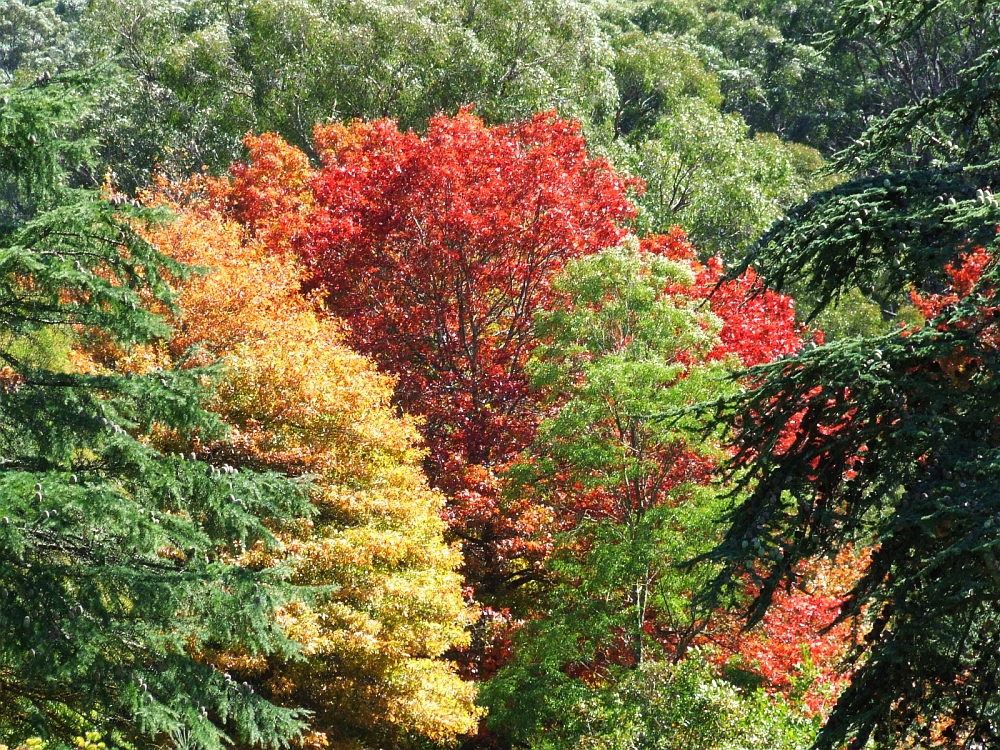
With the summer sizzling ... with the region setting record temperatures ... a lot of people hereabouts are beginning to long for the end of summer. For autumn -- fall, if you prefer. It'll still be hot in the Australian autumn, but you'll eventually start to get cool evenings, morning mists and that holy of holies: rain! The native trees (gums and eucalypts) don't change color, but Europeans brought wonderful deciduous trees with them, and in decades long before our own these trees throve. These days they don't -- there's not enough rain as the drought deepens and only seems to get worse. But many years ago the climate made deciduous trees welcome, and South Australia is rich with them. This picture was taken at the Loftia Botanic Gardens a few years ago. The only thing I'd do differently, today, is -- I'd use 6MP instead of 3MP. When I got this image, my cards were 80% full and I was shoehorning for space. Wouldn't you know it? A lot of the best images were done in the last 20% of the shoot ... at 3MP. To compensate for this, in the computer I reduced the gamma properties, sharpened the image, and resaturated the color a little. Photo by Jade, 2006.

Tuesday, January 27, 2009

Stop and smell the flowers

wildflowers-red
Click here to view the whole image at full size.

October downunder: springtime, warm and bright, but not yet so hot that the landscape is parched and burned out. Everything is green as Ireland, and this is the time when wildflowers carpet the woods with delicate blooms like this one, above. Scores of different kinds of flowers seduce photographers into the forest, but like wild blooms anywhere, they can be extremely small. You'll be on the macro setting, and if you want really great results, get a firm handle on your manual focus. The tricks? Patience; good eyes, to pick the right flower; steady hands to hold focus in the macro range. Digital cameras are a godsend; you can botch forty shots, erase them fast before anyone else sees them, and come back with perfect photos -- all at no cost! Photo by Jade, 2007.

Tuesday, January 20, 2009

Ripples in a Pond


Click image to view at 800 pixels wide.

This was simply an opportunistic frame -- the play of reflections of trees and sky in pond water, rippled by wind. Nothing clever, just point and shoot, but look at the texture, the motion of the water -- there is beauty in the simplest thing. This was an afternoon at Mt. Crawford Forest, May 2008; Fuji FinePix S5600, on automatic. Photo by Mike, 2008.

Monday, January 19, 2009

Gone bush!

outback
(You are viewing this image at full size.)

Gone bush. The words have an almost mystical quality about them in this country, because they mean ... packed up the tent and gone waaaay out yonder, well beyond network coverage, won't be back till Tuesday, earliest, so don't come looking. They can also mean, "Have vanished for the foreseeable future, gone 4x4 adventuring, will be back when I'm good and ready, with an esky full of barramundi on ice." In other words ... civilization has been shrugged off, one has returned to nature! The quest for sanity has commenced! This imaged is through the windscreen, on one of the access roads leading to the Deep Creek Conservation Park. It's primordial ... raw ... primal. Some of my best pictures are through the windscreen. The rules are simple: clean the glass to avoid "ufos;" zoom out to about 100mm to get past the windscreen wipers and windscreen surround; try to keep the radio aerial out of the picture -- or crop it out later; set a fast shutter speed, because the car is moving and all roads are bumpy; and watch out for the sun direction, because if the light falls directly through the windscreen you'll get "glare," and a reflection off the dash mat into the glass. Stick to these rules and you can get some amazing pictures. Have fun! Photo by Jade, 2006.

Saturday, January 17, 2009

Winter trees, blue skies

mossy-trees
Click here to view at full size.

Winter is my favorite time of year -- I don't like the heat. Winter is the time when the landscape of South Australia is green as Ireland, and since the native trees don't drop their leaves, you have what appears at first glance to be a European summer landscape ... green hill and lush, abundant trees. Look again! The deciduous trees which were planted here in profusion by the European settlers are all skeletal, leafless, and ... mossy. Here's your clue to the fact that you're in winter, no matter what the rest of the landscape looks like. Which means you have to be in the southern hemisphere, by default! The conditions were brilliant though the day was cold. Bright conditions made for small apertures and ultra-sharp pictures. Fuji FinePix S5500, digitally enhanced in software later. Photo by Jade, 2007.

Monday, January 12, 2009

Fall comes to the Fairbanks hills

alaska-fall-colors

The further north you travel, the earlier autumn arrives ... and the shorter the time it stays! Fall in Alaska is a ripple which begins in the Arctic and heads south, and in any one place it only touches down for a few days before the leaves fall and winter seems to be knocking at the door. In the hills around Fairbanks -- the location of this shot -- you can be sure you've wandered into an enchanted forest. The whole world seems to have turned gold ... but it doesn't last. You seize the opportunity and shoot ten or twenty rolls of film, fast as you can! This picture is a scan from a print made in 1999. The camera was a Pentax K-1000; the lens was probably the Tamron 80-200mm zoom. The film stock would have been Kodak Royal Gold. It was scanned at 600dpi not long ago, and enhanced in Irfanview. (My best work from the era was done on transparency ... difficult to scan on the desktop, even if I had access to the slides, which I don't. Alas, they're in storage.) Photo by Mel, 1999.

Thursday, January 8, 2009

The view from the Giant's Cave

view-from-giants-cave
Click here to view at 1000 pixels wide.


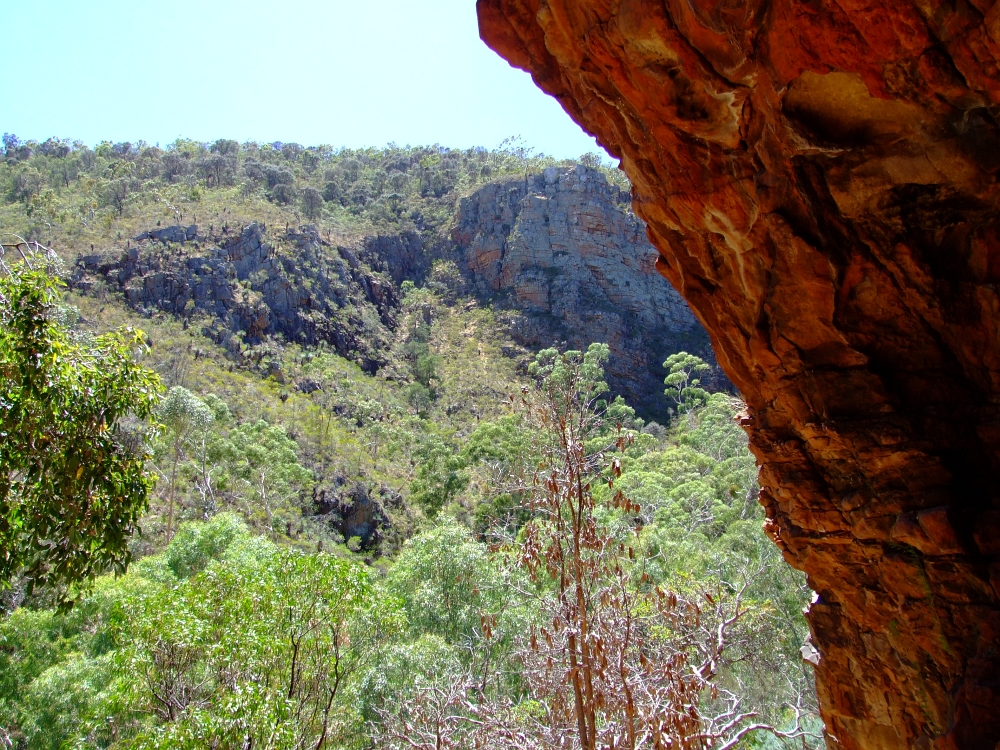
You'd never believe this location is just couple of miles from the suburbs of a major city. As the caption suggests, it's the stunning view from the mouth of the so-called Giant's Cave, at Morialta, near Adelaide, South Australia. The weather was warm and humid -- not hot, but it felt hot with the moisture-laden air. Bright light, excellent "seeing" conditions. Fuji S6500fd, 100 ASA, auto exposure and focus. In bright conditions, the camera can often be left to its own devices! Photo by Mel, 2008.