Showing posts with label fossils. Show all posts

Friday, April 3, 2009

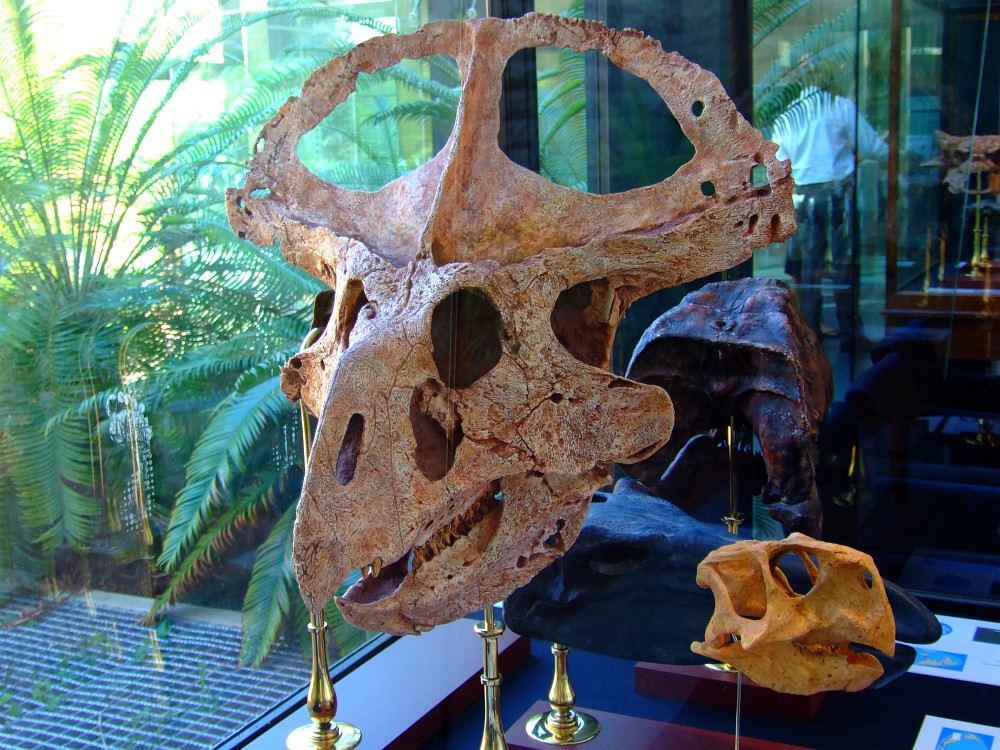
Fossils, front and center!

paleontology-week
Click here to view at 1000 pixels wide.

Palaeontology week at the South Australian Museum of Natural History offered some fantastic opportunities to pit oneself against a slippery opponent: glass. The exhibits are all behind (or under) glass, of course ... and it's daylight, which means that trying to get a good photo of an amazing fossil entails finding some way to get the "glare" out of the shot! You can find yourself taking an excellent portrait -- of the photographer, reflected in the glass. There's no real trick to it, but there's a few guidelines to follow, if you're wondering how in the world to get a usable shot. First: observe. Use your eyes. Don't let your brain merely "tune out" the reflections -- see them! Second: use your feet and knees. Move around and duck down, till the reflections are either minimal, or gone. The camera might try to focus on the glass itself, so be vigilant ... make sure it focuses where you want it to. Lastly, the light levels will be low, so set your virtual film speed at 800 or higher, if you're working in Manual mode; and if you're working in Auto mode, take a great number of shots till the camera gives you exactly what you want -- and erase the dross! Photo by Mel, 2009. (Palaeontology Week, late March 2009; in the foyer of the SA Museum. The major skull in the case is Protoceratops.)

Friday, March 27, 2009

Stone Bones


Click image to view at 800 pixels wide

Big things can be difficult to frame, hard to hold focus on, and lighting can change across their area. This is the famous Diplodocus longus skeleton at the British Museum (Natural History), one of those distributed by the philanthropist Andrew Carnegie, based on a specimen from Sheep Creek, Wyoming, unearthed by the collector Barnum Brown in 1901 (if I remember my palaeontology trivia correctly!) I visited the museum in December 2006 and was amazed to find that photography for personal use was as welcome among the great collections as in any other English museum (it's not in Australia!) I took dozens of frames around this 80+ foot animal, from every perspective, and it was far from easy to get an overall image of the critter. Closeups on various bits and from unusual perspectives, but a single view of the whole beast? I walked around it for fifteen minutes, framing and adjusting and snapping. The light was also a little soft, necessitating a long exposure, thus the sharpness of this shot is important too: note the burning-out of the tall windows at the back and the blur of the man walking in the frame. Fuji FinePix S5600, automatic. Image by Mike.

Friday, January 23, 2009

A snapshot of prehistory

trilobite
(You're viewing this image at full size.)

This was an exercise in steady hands -- the light conditions were very low -- and, later, in digital enhancement. The trilobite lives at the Adelaide Natural History Museum, and as with all museums, the light is dim. Photography is allowed, so long as flash is not used and the images are not intended for commercial use -- as in, publication (meaning, books, magazines. I can't imagine why a museum would have a problem with a picture being blogged). The film speed on the Fuji 6500 was set at about 800, and still the shutter speed was looooong. The fossil is also quite small; you're on the borderline of macro photography here. The trick was to hold the camera extremely steady. Later, I adjusted the image for contrast and color saturation, and the result is striking. The fossil is going to be something like 300 million years old -- all the trilobites perished in the great extinction 250 million years ago. This one is beautifully preserved. Photo by Jade, 2008.