It's an amazing contrast, an Egyptian obelisk whose native environment is the heat and dust of the Middle East, or at best the green vales of the Nile, yet here it is framed by the deciduous leaves of an English autumn, in fact winter. This obelisk stands on the banks of the Thames in the grounds of the Royal College of Music (which inhabits the buildings erected at the end of the 16th century as the Seamen's Hospital). It's not an original brought from Egypt, this one was built in the 1850s as a commemoration of a young French adventurer, Joseph Rene Bellot, who died in 1853on an expedition searching for the missing ships of Sir John Franklin in the Canadian Arctic. Thus it's extremely fitting that it was built at Maritime Greenwich, a stone's throw from where the Cutty Sark has lain since 1950. The image was taken at high telephoto from outside the boundary railings, the framing excluding buildings and the endless London skyline, and the colour, contrast and focus were tweaked for publication. Fuji FinePix S5600, automatic; November, 2007. Image by Mike.
Tuesday, April 7, 2009
Monday, April 6, 2009
MY branch!
If you don't have a widescreen monitor and would like to see the 1000 pixel wide shot, then just click right here.
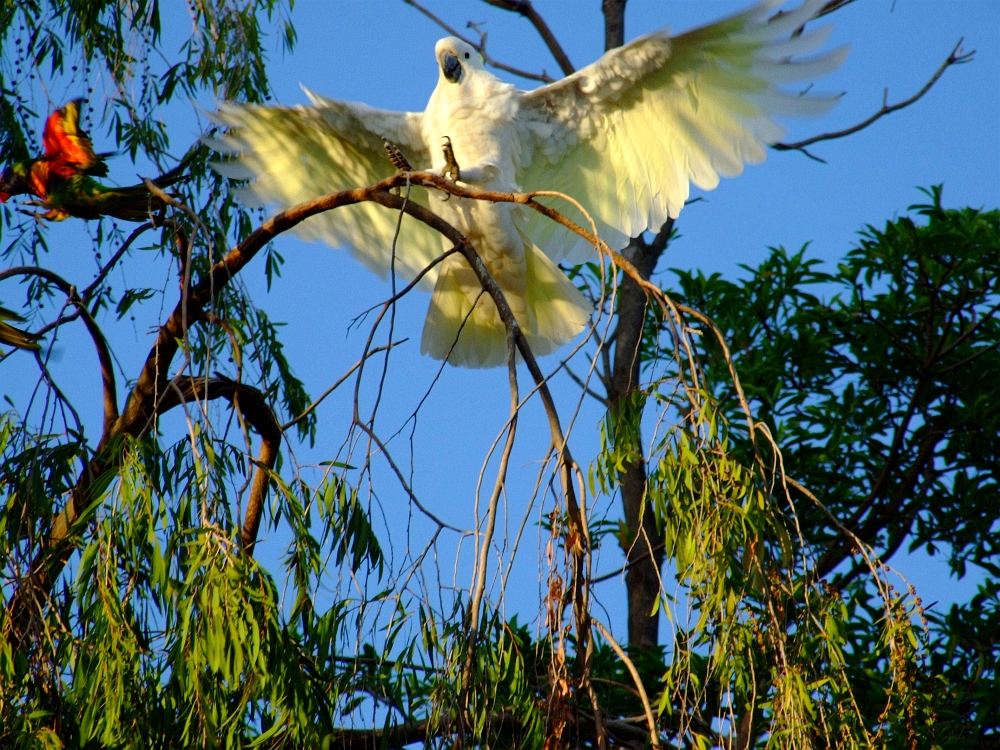
I do like to take parrot pictures. Maybe because there are so many wild ones around here and I never saw them back in Alaska. This was taken early in the morning and the sun was just up. The sun was shining directly at the landing cockatoo. I was actually taking pictures of the little rainbow lorikeet that's flying away and tripped the shutter right after this big bloke jumped from a branch about 3 feet behind this one. Guess he just really wanted his picture taken. the Fuji S6500fd does quite good work in these conditions, and I didn't even have the shutter set for high speed pictures. It was manual focus, but everything else was on automatics, and no colour fixing was down in the computer. Very handy camera. Photo by dave.
Cafe culture goes way upmarket
Click here to view entire image at 1000 pixels wide
Low-light photography offers a whole suite of challenges in either optical or digital, and your solutions to these tests might be different on different days (or shoots). It all depends what results you want: the pro might want a tack-sharp image without grain, because s/he is more than likely shooting for a brochure. The amateur will want a good, clear shot, and can afford to live with a little grain, since the image isn't going to be published, much less at large size. Either way, your choices (your solutions to the challenges) will define this project: stop the action, or "correctly expose" the background, produce fantastic depth-of-field with blurred figures, or accept a little grain in the shot...? It's all about film speed, aperture, and shutter speed. Here's a few ground rules to help you make the decision: high shutter speeds will stop the action (no blurry figures), but you'll need either (or both) bigger apertures or faster film speed to get those fast shutter speeds. Big apertures cost you depth of field, and fast film speeds give you grainy images. Long shutter speeds give you blurry figures (anything that might be moving), plus the probability that you'll get "camera shake" during the exposure, which means the whole shot is blurry. Somewhere among all those "downsides" is a happy medium, and depending on what you need or want out of the finished shot, you'll make your decision. Photo by Mel, 2009. (The National Wine Centre, Adelaide, South Australia.)
Last of the "Wooden Walls"
Click image to view at 800 pixels wide
Now here is living history: the last surviving warship of Georgian times, HMS Victory, which though she has been preserved in drydock as a British national treasure also remains a commissioned vessel in the Royal Navy. The Captain and Executive Officer have reserved parking places next to the ship... This ship, Nelson's flagship at the Battle of Trafalgar in 1805, typifies the 'wooden walls of England' that protected the country from invasion in the warlike 17th and 18th centuries, and is the technological ancestor of 1869's HMS Warrior, which lies a few hundred yards away at the Historic Portsmouth Naval Dockyard. I visited on a grey day in December, 2006, a day when rain was sweeping through in light, cold showers and the overcast made exposures difficult. Note that the sky is burned out to white to properly expose the ship. She was simply too big to frame the whole ship properly amongst the jumble of buildings surrounding the drydock, but I captured many excellent detail closeups. Sharpened, contrast- and colour-enhanced for publication. Fuji FinePix S5600, automatic. Image by Mike.
Labels:
England,
exposure latitude,
historic,
HMS Victory,
military,
Portsmouth,
sea,
ships
Sunday, April 5, 2009
In the time warp ... Adelaide, of course!
Click here to view at 1000 pixels wide.
Architecture fascinates me, with the way it pretends to be anywhere but where it is, and in any time period but our own. And nowhere in the world is more of an architectural time warp than the North Terrace area of Adelaide, South Australia. In five hundred meters, you can see 1970s modernism, Romanesque frontages, nineteenth century colonial Australian, eighteenth or nineteenth century British India ... and then you get along to Adelaide University, and -- dang! This one is pretending to be a fifteenth century castle. It's absolutely magnificent. These are the hallowed 'halls of learning,' of which students and visitors can tell you a few rare stories! The image was easy to capture, just a question of getting close enough to put the sun just behind the roof there. This threw the building into silhouette and burned out the sky, of course, but this was easy to fix at the software level later. I might have stuck around and done the perfect manual exposure, but to get this shot at all was a question of patience: taxis backing in and out, students by the thousand trooping by. Eventually, you grab what you can and enhance it later. Thank heavens for digital photography! Photo by Mel, 2009.
Labels:
Adelaide,
architecture,
built environment,
castle,
flags,
medieval,
universities
Visual Contradictions
Click image to view at 800 pixels wide
Industry has to be somewhere, but the mind usually pictures it clustered around polluted rivers, or in areas sterilised by contamination. Thus the contradiction of this steam-belching installation (nuclear power station, perhaps?) surrounded by the rich greens of the English countryside. Somewhere in the Midlands, this frame was captured from the window of an express on the line between London and York in November, 2007. The eye is on one hand soothed by the farmland all around, yet offended by the ugly organic shapes of the cooling towers and their endless belch of steam that contributes to the overcast. Enhancements include sharpening, contrast and colour saturation. Fuji FinePix S5600, automatic exposure, high-end optical zoom. Image by Mike.
Labels:
England,
industrial,
telephoto photography
Saturday, April 4, 2009
Perspective Compression
Click image to view at 800 pixels wide
Sometimes you see the most unexpected things, and it's good to have a camera handy. I had just arrived at my boarding house in Sunderland, near the seafront, having dragged my bags up from the St. Peters railway station, and what should I see on this cold, bright, windy afternoon, but a ship manoeuvring to enter Sunderland harbour via the twin breakwaters. It was a real gift for a spot of maximum telephoto action and the phenomenon of perspective compression. The foreground and background in focus simultaneously suggests the ship is much closer than it really is. Sharpened, contrast-tweaked and colour-enhanced. November, 2007. Fuji FinePix S5600, automatic. Image by Mike.
Labels:
England,
harbour,
ocean,
sea,
ships,
Sunderland,
telephoto photography
Friday, April 3, 2009
Fossils, front and center!
Click here to view at 1000 pixels wide.
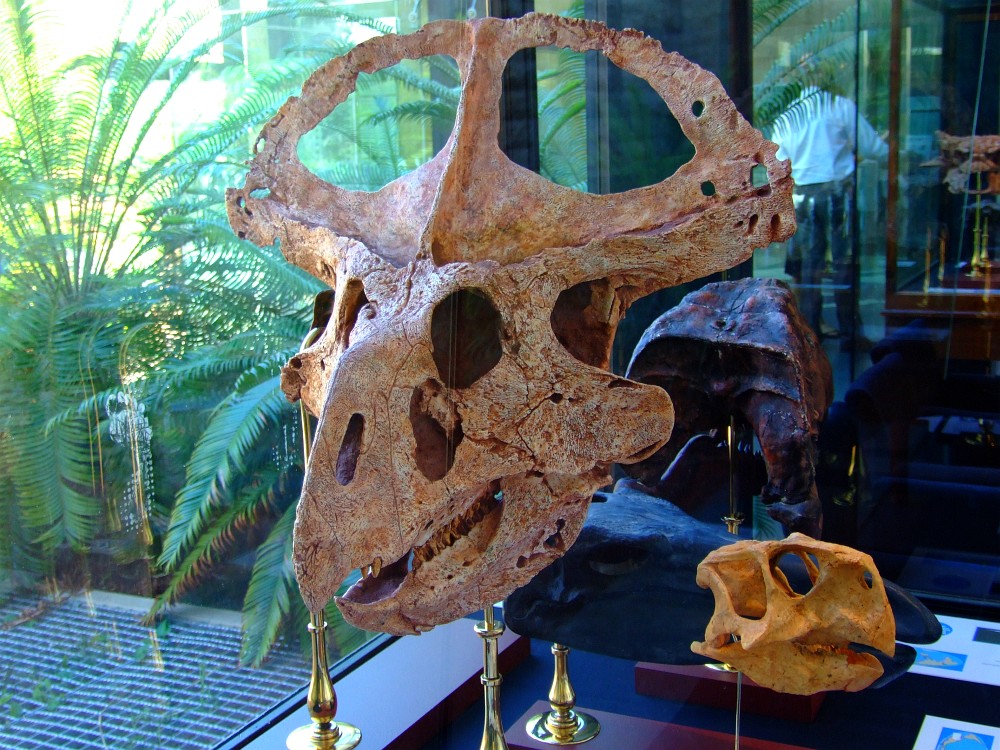
Palaeontology week at the South Australian Museum of Natural History offered some fantastic opportunities to pit oneself against a slippery opponent: glass. The exhibits are all behind (or under) glass, of course ... and it's daylight, which means that trying to get a good photo of an amazing fossil entails finding some way to get the "glare" out of the shot! You can find yourself taking an excellent portrait -- of the photographer, reflected in the glass. There's no real trick to it, but there's a few guidelines to follow, if you're wondering how in the world to get a usable shot. First: observe. Use your eyes. Don't let your brain merely "tune out" the reflections -- see them! Second: use your feet and knees. Move around and duck down, till the reflections are either minimal, or gone. The camera might try to focus on the glass itself, so be vigilant ... make sure it focuses where you want it to. Lastly, the light levels will be low, so set your virtual film speed at 800 or higher, if you're working in Manual mode; and if you're working in Auto mode, take a great number of shots till the camera gives you exactly what you want -- and erase the dross! Photo by Mel, 2009. (Palaeontology Week, late March 2009; in the foyer of the SA Museum. The major skull in the case is Protoceratops.)
Aspects of the Journey
"Inward, Looking Outward" could have been the title of this post. This was one of a batch of frames I took late one evening in November, 2007, at Heathrow Airport, London, while waiting for my outbound flight, a Qantas Boeing 747-600, the Longreach, named for the original headquarters of the company in Queensland. It was delayed four hours due to weather on the flightpath, a great many disgruntled people could only sit around and wait. At least I had photography to help pass the time! Had lighting been less bright maybe shots through the plate glass could have been managed to create an outside perspective such as with my shots at Newcastle Airport earlier the same evening, but that was never going to be possible here, and this time the reflections tell their own story: two images, superimposed, the travellers in the lounge and the plane they are about to board, interleaved, thus two aspects of the journey. Sharpened and colour-saturated for publication; Fuji FinePix S5600, automatic exposure. Image by Mike.
Labels:
air travel,
airplane,
airports,
England,
glass,
Heathrow Airport,
London,
night photography,
reflections
Thursday, April 2, 2009
True Antiquity
Click image to view at 800 pixels wide
It's not often you get to focus on a manmade object that is some 14000 years old. This is a carved antler artifact from late Palaeolithic times which I had the privilege of actually touching at a touch-and-tell exhibit at the British Museum in December, 2006. It i's humbling to think that human hands shaped this piece of organic material and carved in the decoration long before the world as we know it began to take form. The photograph was taken in available light on macrofocus setting, and was simply a case of framing the composition and releasing the shutter: photographically it was a no-brainer, but to see the object is to feel the gulf of time between the maker and the beholder, and it demanded to be recorded. Sharpened and colour-enhanced for publication; Fuji FinePix S5600, automatic exposure, macro range. Image by Mike.
Labels:
antiquities,
art,
artifact,
British Museum,
London,
macro photography
Reflections teasing eyes and brain
Click here to view at 1000 pixels wide
Water is the most amazing element I know. Glass can reflect and to a degree can also distort, but there's nothing else in nature for twisting your perceptions of the second, third and fourth dimensions than water. Consider this: water offers a pseudo 2D surface. You think it's flat, but even when it's at its most calm, it's not perfectly flat. It's curved into the third dimension however fractionally. Now, true 3D objects are reflected in it, and their reflections drop a dimension. A 2D reflection of a 3D object (ie., an image) cannot be the same as the object -- there are massive sacrifices to be made for the conversion from 3D to 2D. Now, take the 2D reflecting surface and warp it into the third dimension -- the way water ripples. Weirdness results ... but our human eyes are so accustomed to reflection, they "tune it out." But here's what will really challenge your brain: try to imagine a 4D object reflected in the "surface" of the third dimension ... and then allow for ripples in the third dimension caused by gravity wells and tides... good gods! We could be looking right at (or through) 4D creatures, and not knowing what they are. Anybody want to run with this and extrapolate it as the ultimate rational explanation for paranormal apparitions ... ghosts, demons, sprites, angels ... even alien encounters?! Photo by Mel, 2009. (This is a surface shot of the Amazonian lily pool in the incredible new Amazon exhibit at Adelaide's Botanic Gardens.)
Labels:
fish,
plants,
reflections,
water,
water lilies
Wednesday, April 1, 2009
Neoclassicism
Click image to view at 800 pixels wide
Neoclassicism -- the New Classical approach, be it in architecture, art or social thought -- was a fascination with 'respectable antiquity' that swept the world in the 18th and 19th centuries. The styles of ancient Greece and Rome were supplemented with those of Egypt when archaeology, barely emerging from its anitquarian forebears, made its early discoveries there (obelisks sprang up in cemeteries all over the world as grave markers). London is a very Neoclassical city, in which a great number of buildings dating from the 1700s and 1800s reflect the grandeur of antiquity, and this particular one, on Whitehall, caught my eye for the statues recessed in niches on the facade. This is truly ostentatious by modern standards, and sculptors were on a good living in centuries gone by. The aspect remains magnificent, even in this age of steel and glass. The shot was a simple one, automatic exposure plus telephoto to fill the frame with the subject matter. Mild enhancements include sharpening, contrast and colour saturation. Fuji FinePix S5600, November 2006. Image by Mike.
Labels:
architecture,
built environment,
classical,
England,
historic,
London
Subscribe to:
Posts (Atom)