Tuesday, February 3, 2009

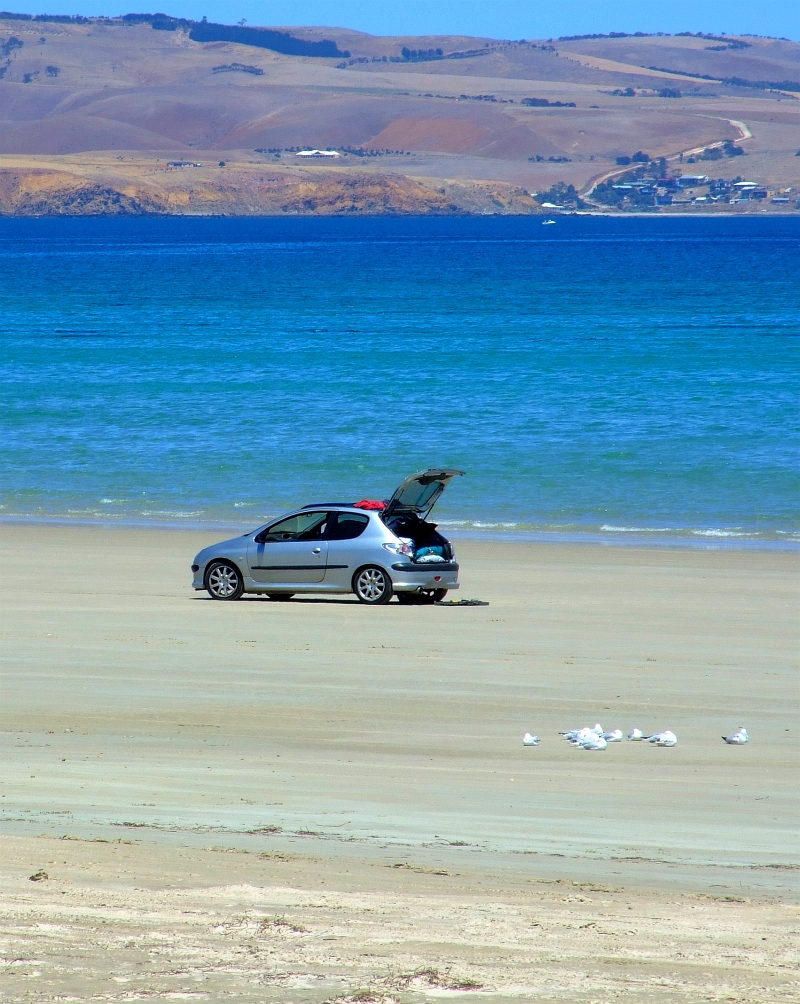
A drought-scourged panorama

panorama
Click to see the whole image at 1000 pixels wide.

On a roasting day in summer, you've just jolted down the most horrific road in South Australia. You're not quite sure if your knee or shoulder joints are still attached, and if your kidneys are where they used to be! But the reward for making it down the road to Myponga Beach is glorious peace and quiet and a panoramic view from the ocean to what seems to be sub-desert but is in fact sheep grazing country that's being scourged by drought. Up on the hill is a station house ... and here's where it gets interesting. Refer back to Sand, sea and sun, Aussie style, which was uploaded a few days ago, and look at the top of the shot. There's the same house, seen in the distance, photographed from Silver Sands, near Aldinga ... and in the previous shot you can also see that horrific road down the hillside! That's what you drive in order to get to the location above. Dramatic though this shot is, it was also easy to get. I remember the day being so hot that I left the Fuju 6500 set on full auto and let the gadget do the work! Photo by Mel, 2007.

Quick Fix

Let's say you've taken a picture which would be GREAT. The focus is spot on, no camera jitters, beaut! Except for the fact you had to take the shot quickly (no time to go to manual settings on your wonderful digital camera), and the annoying fact that the sun was right in front of you.

Say, perhaps something like this:
DSCF5300


No worries though, cus in one or two mouse clicks it can look like this:
fixed


The fix is done using Irfanview, a free and awesome imaging program. All I did was turn the gamma from 1.00 to 1.48, the contrast from 0 to 25 and two clicks of sharpness (I set each click for a value of 2%).

You can do a lot with Irfanview, give it a go and experiment.

Photo and enhancement by dave.

The flowers of deep winter

red-flowering-tree
Click here to view at 1000 pixels wide.

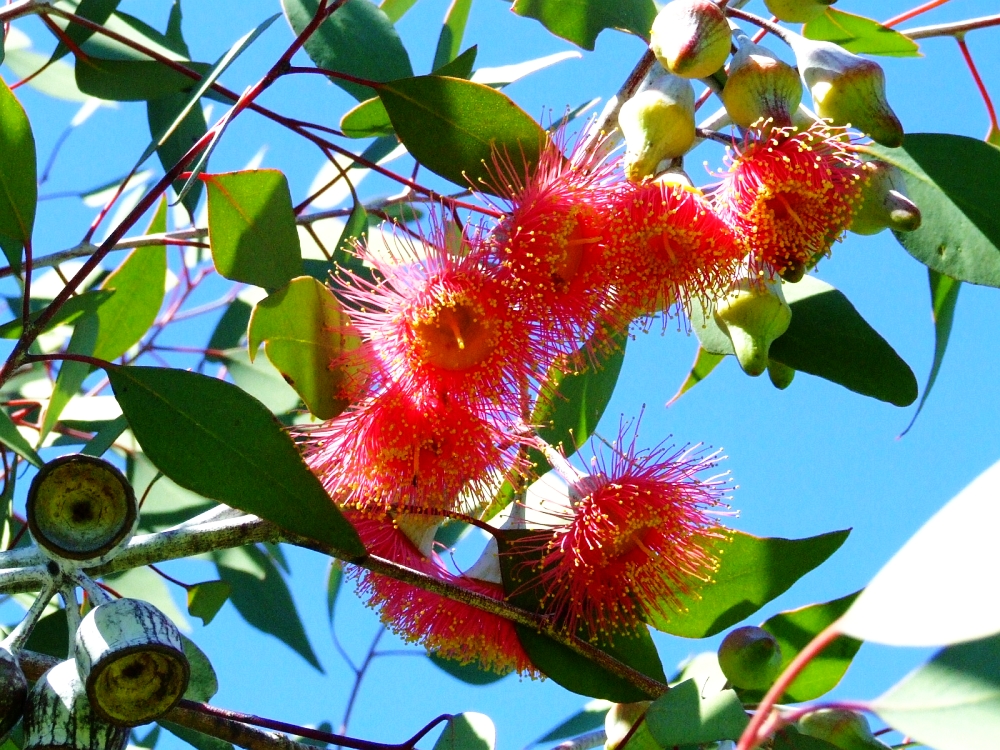
Living in the northern hemisphere, you'd be used to a cold, often icy winter in which nature lies dormant. Coming to the south, you experience the exact opposite -- and it can take a few years to grow accustomed to it. "Downunder," things come alive in winter, when the sun is less fierce, and it (gasp!) rains. Winter is the time of green, cool, flowering trees, flowering shrubs, flowering plants. If it can flower, between May and October -- it flowers! In this picture I've captured a closeup on eucalypt flowers ... "gum nuts." Massive trees will be covered with these, and you'll be amazed by the drone of bees. The most difficult aspect of getting this photo was to make sure the camera calculated its exposure on the flowers and nuts, not the sky. You can do this by shifting the camera around until a flower or nut is in the right place to influence the light meter ... or by setting the camera to its Manual (M) setting and experimenting till you get what you want. The beauty of digital cameras is, you can then delete all the setup shots and keep only the good ones, and it costs nothing! (Back in the days of optical cameras, we used to "bracket" exposures for difficult and important shots, and -- oh, it got expensive, with shots on transparency costing upwards of $1 each, in 1980!) Photo by Jade, 2006.

Moose on an Arctic evening

moose-on-turnagain
Click here to view at 1000 pixels wide.

This is a photo that was easy to get ... and very difficult to make "good" in the computer. It was taken with an Olympus optical SLR, about 1999, and little did I know at the time, the camera had a light meter problem: it wasn't reading properly. It took quite some time for me to diagnose the problem -- the first thing you do is blame yourself for botching up the shot. (Not guilty!) This one could be salvaged in the computer. It was easy to capture: I stood on the roadside with about 50 other people, all of whom had noticed a pair of moose grazing the swamplands just off the landward side of the Seward Highway, which hugs one side of Turnagain Arm, heading out of Anchorage, Alaska. The lighting conditions were low: overcast, with the sun down behind the Chugach and the Alaskan twilight getting ready to last through till dawn. Ten years later, the flat, rather murky print was scanned at 600dpi, then resized to 1000 pixels wide to display properly on average monitors ... and then the fun began. You're juggling contrast, gamma, color saturation, and the hues themselves. All these parameters were adjusted many times to achieve the result you see here. Photo by Mel, 1999.

Celebrity Snapshot... Almost


Click image to view at 800 pixels wide

London, December 2006 -- any old afternoon. I had left the British Museum in search of an ATM, which I found at a Sainsburys a few streets away, to conjure cash for a bite to eat, and was about to cross when a clamour of sirens cleared the streets. Pedestrians clustered at the corners waiting as Police bikes halted traffic, and I heard someone say the man in the top job was going through. The FinePix S5600 was always around my neck, so I scoped in on the intersection for a reflex shot and snapped the Prime Ministerial Daimler as it raced by. Full automatic, of course! Photo by Mike.

Monday, February 2, 2009

Mirror, Mirror On The Wall

moth reflecting closeup


A few weeks ago I was cleaning the outside windows. As I was about to start this window I noticed what I thought was a big hunk of dirt on the window frame. Upon closer inspection I saw that it was a moth on the wooden frame right up against the glass making a nice reflection. The fact that it landed next to a nail head made it look really cool. Went inside and grabbed the trusty Fuji S6500fd, set it to macro with auto focus and got this shot from two inches away. Didn't have to do anything to the pic, it came out perfectly just like the moth looked like in real life. I thought about trying the super-macro setting, but I didn't want to disturb by getting any closer. Needless to say, I didn't wash that particular window that day. Photo by dave.

How the other half live ... wow!

panorama-02
Click here to see the whole panorama at 1000 pixels wide.

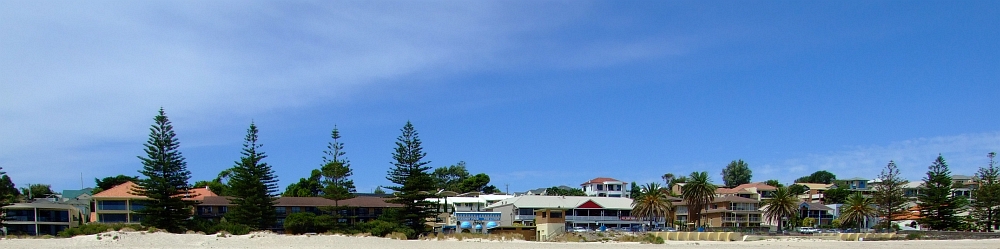
I got interested in panoramic shots a while ago, while traveling overseas. Some locations offer the most amazing mid-range material, while the top and bottom of the frame are ... blah. Like this one. It's the line of millionaires' houses and Norfolk Island pine trees that are the interesting segment of the photo. The upper third is just sky, and the bottom third --? I was standing in the water to get this, so you can imagine what the bottom third was all about. The best thing to do is photograph the whole scene at the max resolution you have ... 6MP is just fine; 10MP is superb, but you'll need one of the newer cameras to get this. (Incidentally, check the Digital Kosmos Store, to the right of your screen: you'll see the new Fuji at a good price -- and it would do this job perfectly.) However, this shot was captured with 6MP, and I don't have a problem with it. In your imaging software, just crop the wide shot out of the whole frame, then size it to what you need, sharpen, and adjust color, brightness, contrast and color saturation, if you need to or want to. The results? Beautiful! This photo was taken from the waterline at Seacliff, Adelaide. Photo by Jade, 2007.

Mobile artwork

mobile-artwork
Click here to see the entire image at 1000 pixels wide.

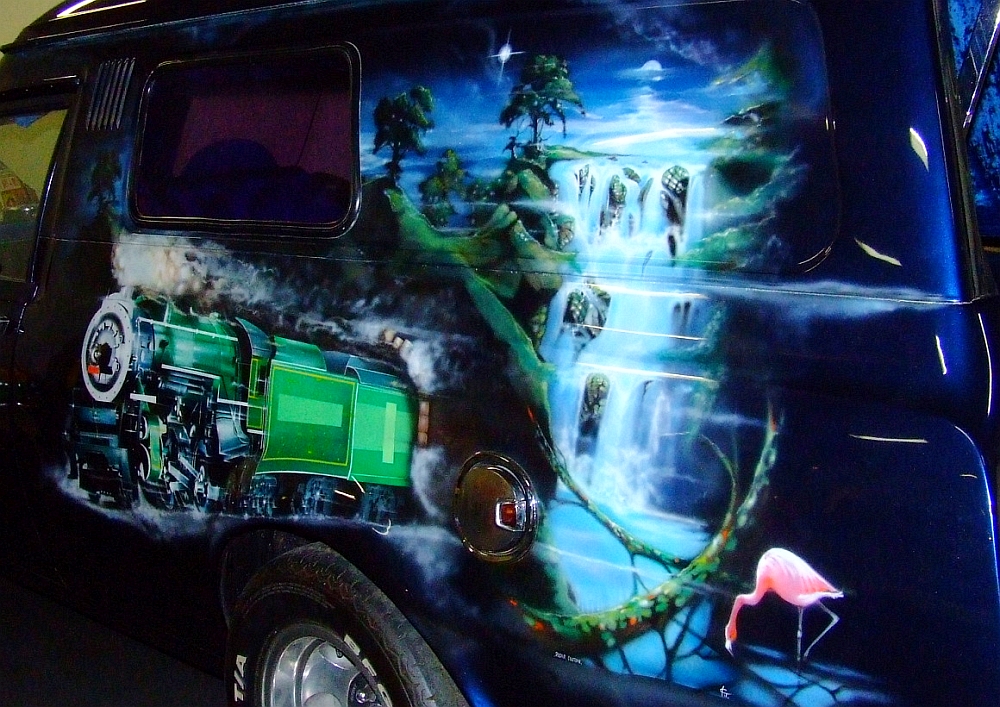
Getting this picture was an absolute nightmare, because the vehicle is standing in lighting conditions which are virtually dark. It's a 1970s panel van -- they were tremendously popular with late teens and early twenties in those days; you'd see them on the beach. Now? The best specimens are in museums! This one is in the National Motor Museum, in Birdwood, South Australia. It's a beauty ... the airbrush art is classic. Brings back a lot of memories! But getting the photo was a major headache, because it was so dark. If you popped the flash, everything would be a mass of glare, with glass and chrome reflecting like mirrors. The answer? A long exposure. When you're walking around a museum, you don't go armed with a tripod! Photography is welcome there, but I think they'd draw the line at people fronting up with a load of professional gear. The solution was to sit the camera on the hood (or bonnet, if you're an Aussie) of a nearby vehicle and trip the shutter gently. The photo still needed a bit of digital enhancement ... but here it is! Photo by Mel, 2006.

Scoping the Ruins


Click image to view at 800 pixels wide

The Fuji FinePix S5600 has a dual zoom function, an optical zoom plus a digital zoom that creates a second range at the penalty of gradually degrading image quality (it pixelises). The zooms are pretty powerful, 12x in each range, so finding a subject far enough away to really do justice to the available power can be a bear. This was a zoom test when the subject matter appeared -- it was late November 2006 and I was standing in the forecourt of Pannet Park Museum, Whitby, North Yorkshire on an overcast, soft evening (my batteries were about to give out in a few more frames, another nuisance!) I scoped in on the ruined Abbey on the East Cliff, right across the harbour and valley of the River Esk, the distance would have to be a straight line of 1000 yards or more. This was maximum optical zoom, retaining full resolution. The image has been cropped to drop out a pesky flagpole and an exra rooftop, and sharpened a little, but otherwise this was very much how it looked through the lens. Exposure was fully automatic. Image by Mike.

Sunday, February 1, 2009

The migrant turtle dove

turtle-dove
Click here to see the whole image at 1000 pixels wide.

Turtle doves are found all over Australia -- they're one of Mama Nature's greatest survivors. They can stand the weather (both summer and winter), and they eat ... well, everything. In fact, they're so prolific and numerous, it comes as a surprise when you learn that they're not native to the country. In fact, they originated in India, and would have come to Australia with migrants, probably some time in the late 19th century ... and I have a feeling it would have been British migrants who were partial to pigeon pie! This is a telephoto shot at6MP, cropped at top and bottom, and resized. I didn't touch the color or contrast, but I did tweak the color saturation a tiny bit. The camera was the Fuji 6500, which is great at capturing birds that are not too far away, and/or not too small -- it has a 10:1 optical zoom, and the 6MP feature gives you plenty to crop into. Photo by Jade, 2007.

Sand, sea and sun -- Aussie style

day-at-the-beach
Click here to view the whole image at 800 pixels wide.

There's nothing like it: you're the only human soul in twenty miles, with a white beach the size of the county of Hampshire all to yourself. The sky is a blue beyond description, the sea is still as a pond. Put a line in the water to catch dinner, get the tents pitched, kick back and enjoy. It's Silver Sands, near Aldinga, South Australia ... where else? We were down there for a couple of days, and right on cue the weather turned blisteringly hot. No surprise, in Australia in the summer! The toughest part of capturing this picture was keeping the contrast under control. The digital camera wanted to turn the beach white as bleached bone. The only trick is -- learn to handle your camera's manual settings for apperture, shutterspeed and exposure. All good cameras have these functions ... hit the manual! Photo by Mel, 2006.

Symmetry in Steel


Click image to view at 800 pixels wide

There is something about Victorian engineering that remains both an endearing connection with the past and a reminder of times which for good reasons are gone by. But Victorian engineers knew how to build, and build to last. This is York Station, on the oldest stretch of line in the world. Britain's National Railway Museum, the largest in the world, directly adjoins it. I took this snap on a cool evening while waiting for connections to Middlesbrough and on to my hotel in Whitby. The FinePix S5600 was set for 200ASA filmspeed and automatic exposure, the shot was hand-held, which makes the clarity somewhat remarkable. The image was sharpened but in no way colour enhanced for publication. Photo by Mike, November 2006.